


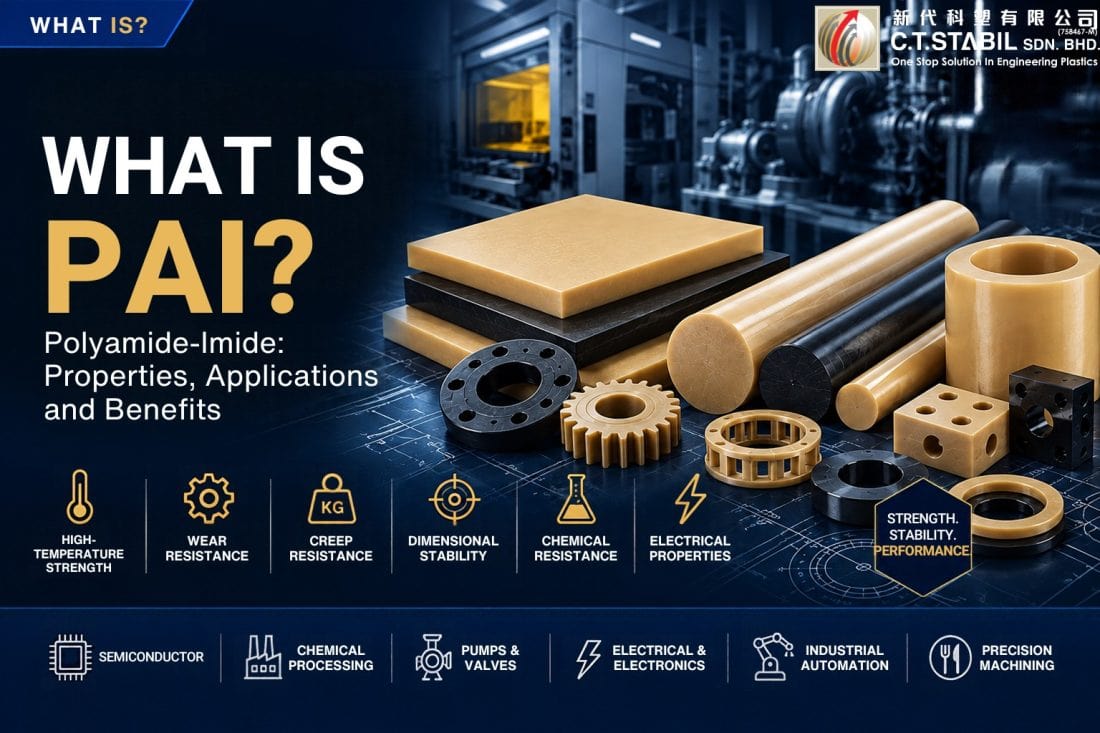
What Is PAI (Polyamide-Imide)? Properties, Applications and Benefits
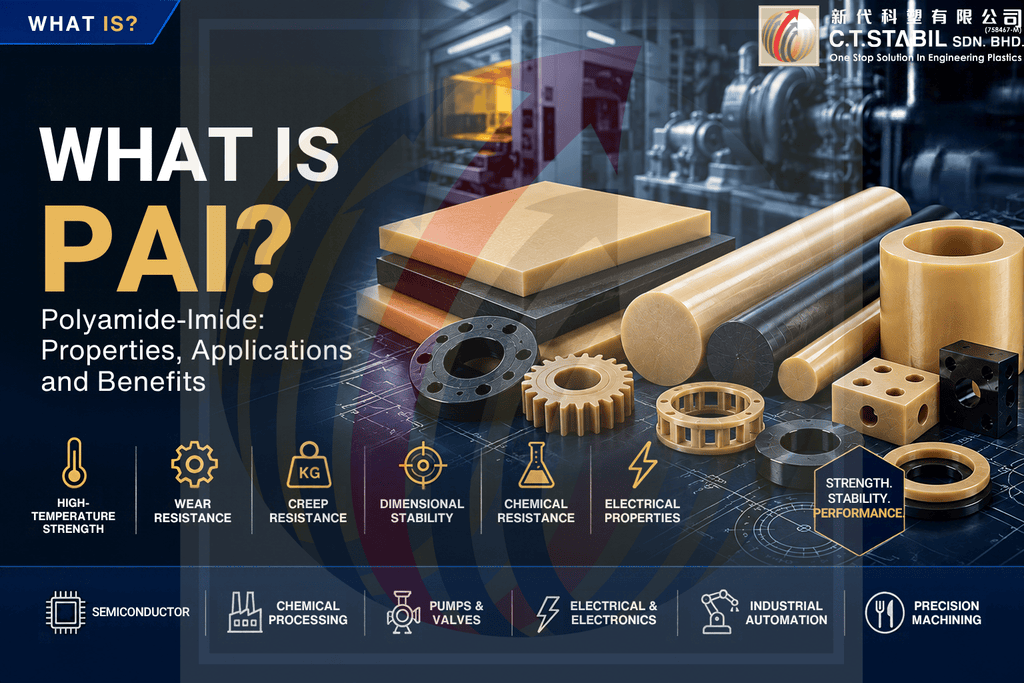
⭐ Material Snapshot
- Material: Polyamide-Imide (PAI)
- Material family: High-performance engineering thermoplastic
- Key strengths: High-temperature strength, wear resistance, creep resistance and dimensional stability
- Typical applications: Bearings, bushings, seals, valve seats, bearing cages and precision mechanical components
- Commercial product names: Torlon®, Duratron™ PAI, TI Polymer and TECAPAI®, depending on manufacturer and product range
Introduction
Engineering components used under high temperatures, heavy loads and continuous friction can place demanding requirements on material selection. Many conventional engineering plastics are suitable for general mechanical applications but may lose stiffness, deform under sustained loading or experience excessive wear in more severe operating conditions.
Polyamide-Imide (PAI) is a high-performance engineering thermoplastic developed for applications where mechanical strength, thermal stability and dimensional control are critical. It is particularly valued for retaining useful mechanical properties at elevated temperatures while resisting creep and wear.
However, PAI is not automatically the best choice for every demanding application. Understanding its properties, limitations and available grades helps engineers determine when it offers a practical advantage over alternatives such as PEEK, PEI, PPS and conventional engineering plastics.
plastics.
What Is PAI?
PAI stands for Polyamide-Imide, an amorphous, high-performance thermoplastic that combines amide and imide chemical structures. This molecular structure contributes to its excellent mechanical strength, thermal stability and resistance to deformation under load.
Depending on the grade and application, PAI can maintain useful strength and stiffness at temperatures approaching 260°C (500°F). Actual service limits depend on the material grade, applied stress, operating environment and duration of exposure. Source: Syensqo
PAI is available in different formulations, including unfilled, glass-fibre-reinforced, carbon-fibre-reinforced and wear-modified grades. These variations allow engineers to select a material according to requirements such as impact strength, rigidity, dimensional stability, friction and wear resistance.
The specific grade matters: two PAI products should not be assumed to perform identically simply because they belong to the same polymer family.
Key Properties of PAI
1. High-Temperature Mechanical Strength
One of PAI’s major advantages is its ability to retain substantial strength and stiffness under elevated-temperature conditions. This makes it suitable for mechanical components exposed to combinations of heat and sustained loading.
Unlike materials selected mainly for temperature resistance, PAI is particularly useful when a component must also support mechanical loads while maintaining its shape.
2. Excellent Wear and Friction Performance
Selected PAI grades offer excellent wear resistance and low-friction performance, making them suitable for sliding and moving components.
Wear-modified grades may incorporate lubricating additives to improve performance in specific tribological conditions. Depending on the grade and operating environment, PAI can be used for non-lubricated bearings, bushings, thrust washers, seals and bearing cages.
Nevertheless, friction and wear depend on more than the material alone. Surface finish, contact pressure, sliding speed, mating materials, temperature and lubrication all influence actual performance.
3. High Creep Resistance
Creep is the gradual deformation of a material under sustained stress, particularly at elevated temperatures.
PAI’s high creep resistance helps components maintain their dimensions under continuous loading. This is valuable for precision parts, seal rings and structural components where excessive deformation can affect clearances, sealing performance or equipment reliability.
4. Dimensional Stability
PAI generally has a low coefficient of linear thermal expansion compared with many conventional engineering plastics. Combined with its creep resistance, this can help components maintain tighter dimensional control across changing temperatures.
Fibre-reinforced grades can offer additional stiffness and dimensional stability, although reinforcement may introduce directional properties that engineers must consider during design and machining.
5. Chemical and Electrical Properties
PAI offers useful resistance to many chemicals and can provide good electrical insulation, depending on the grade. These properties make it suitable for selected industrial, electrical and precision applications.
Chemical compatibility must still be checked against the actual chemical concentration, temperature, exposure duration and stress conditions. Specialised grades may also have different electrical characteristics, particularly where conductive reinforcement or additives are used.
Where Is PAI Commonly Used?
PAI is selected for components that must withstand demanding combinations of temperature, load, friction and dimensional requirements.
Typical applications include:
- Bearings and bushings: For demanding sliding applications where wear resistance and load-bearing capability are important.
- Seals and valve seats: Where dimensional stability and mechanical performance under temperature and pressure are required.
- Thrust washers and bearing cages: For mechanical assemblies exposed to friction and sustained loading.
- Compressors and pumps: For selected piston components, sealing elements and other precision parts.
- Electrical and industrial equipment: For components requiring thermal stability, mechanical strength or electrical insulation.
- Precision machinery: For parts where stiffness, creep resistance and dimensional control are critical.
The appropriate grade must be selected for the actual operating conditions rather than the application name alone.
What Are Torlon®, Duratron™ PAI and Other PAI Products?
PAI is the generic material designation, while commercial names identify products marketed by particular manufacturers or suppliers.
Examples include Torlon® PAI, associated with Syensqo; Duratron™ PAI, the PAI stock-shape product family marketed by Mitsubishi Chemical Advanced Materials (MCAM); TI Polymer, associated with Toray; and TECAPAI®, Ensinger’s PAI stock-shape product designation.
These names should not be treated as interchangeable specifications. Available grades, reinforcement, manufacturing routes and performance characteristics can differ. For example, MCAM offers Duratron™ PAI grades designed for different combinations of impact strength, wear resistance, stiffness and dimensional stability. Source: MCAM
For material selection, always verify the manufacturer’s datasheet and the exact grade. C.T. Stabil supplies engineering materials and can help customers assess suitable options based on application requirements.
Is PAI the Right Material for Your Application?
PAI is worth considering when an application combines high temperature, sustained mechanical loading, wear or demanding dimensional tolerances. It can offer advantages over conventional engineering plastics and may replace metal in selected components when the design and operating conditions support the substitution.
However, PAI is a specialised material and generally involves higher material and processing costs than standard engineering plastics. Its moisture conditioning, machining requirements and any specified post-processing must also be considered when manufacturing precision components.
For less demanding applications, materials such as POM, PET, PPS or PEEK may offer a more practical balance of performance and cost. The best choice depends on the full operating environment, not simply the maximum temperature rating.
Conclusion
Polyamide-Imide (PAI) is a high-performance engineering thermoplastic valued for its combination of elevated-temperature strength, wear resistance, creep resistance and dimensional stability. These properties make it useful for demanding bearings, seals, precision mechanical parts and other industrial components.
The key to successful selection is understanding the application’s requirements and choosing the appropriate PAI grade. By comparing operating temperature, load, friction, chemical exposure, dimensional tolerances and total component cost, engineers can determine whether PAI provides a meaningful advantage over alternative materials.
At C.T. Stabil, we believe the best engineering plastic is not necessarily the one with the highest specifications—it is the one that delivers the right balance of performance, reliability, manufacturability, and engineering value for the intended application.
Whether you are designing new equipment or replacing an existing component, understanding the capabilities of PPS is the first step towards making informed engineering decisions.
Continue Learning
Interested in expanding your knowledge of engineering plastics? Continue with these related technical publications:
- What Is PEEK? Properties, Applications and Benefits
- Engineering FAQ #002 – Why Do Plastic Parts Warp During and After Machining?
- What Are G10 and FR4? Properties, Applications and Differences
- Which Engineering Plastic Has the Highest Operating Temperature?
- Techtron® PPS vs Standard PPS: What’s the Difference?
- PEEK vs PPS: Which High-Performance Engineering Plastic Should You Choose?
About CT Stabil Technical Publications
C.T. Stabil Technical Publications is a knowledge series created to help engineers, designers, purchasers, and manufacturers better understand engineering plastics and make informed material selection decisions.
Our publications combine engineering principles, recognised industry practices, manufacturer technical information, and practical application experience to deliver objective, educational, and application-focused content.
Our mission is to simplify complex material selection decisions while promoting sound engineering practices across a wide range of industrial applications.
Article Information
| Information | Details |
| Series | What Is? |
| Publication No. | CTS-WI-007 |
| Article Title | What Is PAI? Properties, Applications and Benefits |
| Technical Level | Beginner |
| Estimated Reading Time | 6 -7 min read |
| Published | October 2026 |
| Last Reviewed | October 2026 |
| Prepared by | C.T. Stabil Technical Publications |
| Technical Review | C.T. Stabil Engineering Team |
Technical Disclaimer
This publication is intended for educational and general engineering reference purposes only.
The information presented reflects commonly accepted engineering principles together with industry references available at the time of publication. Material properties, performance characteristics, and application suitability may vary depending on the manufacturer, material grade, processing methods, operating conditions, component design, and service environment.
Readers should verify all technical information and consult the relevant manufacturer’s technical documentation before making engineering, design, or purchasing decisions.
Nothing contained in this publication should be interpreted as a substitute for professional engineering judgement or application-specific testing.
Copyright Notice
© 2026 CT Stabil Sdn. Bhd. All rights reserved.
This publication forms part of the C.T. Stabil Technical Publications series.
You may quote brief excerpts from this publication for educational or editorial purposes provided appropriate attribution is given to CT Stabil Sdn. Bhd.
Reproduction, republication, or redistribution of this publication in whole or in substantial part without prior written permission is prohibited.
References & Further Reading
The information presented in this publication has been prepared with reference to recognised engineering resources, including:
- Manufacturer technical data for commercially available PPS materials
- Material property information published by leading engineering plastics manufacturers
- ASTM International standards relating to plastics testing and material characterisation
- ISO standards relevant to engineering plastics
- Engineering plastics reference handbooks
- Practical engineering knowledge and application experience from the C.T. Stabil Engineering Team