


Which Engineering Plastic Has the Highest Operating Temperature?
5 – 6 minutes reading
When selecting an engineering plastic for high-temperature applications, one of the first questions engineers ask is:
Which engineering plastic can withstand the highest operating temperature?
The answer is not always straightforward.
While several high-performance engineering plastics can operate in extreme temperatures, each material offers a different balance of heat resistance, mechanical strength, chemical resistance, wear performance, and cost. Choosing the right material depends not only on its maximum temperature rating but also on the specific operating environment.
In this article, we’ll compare some of the most heat-resistant engineering plastics and explain when each material is most suitable.
Understanding Operating Temperature
Before comparing materials, it’s important to understand what continuous operating temperature means.
Continuous operating temperature refers to the maximum temperature at which a material can maintain its mechanical properties and perform reliably over an extended period. This differs from short-term peak temperature, which is the maximum temperature a material can withstand briefly without permanent damage.
For engineering applications, continuous operating temperature is usually the more meaningful specification.
Top High-Temperature Engineering Plastics
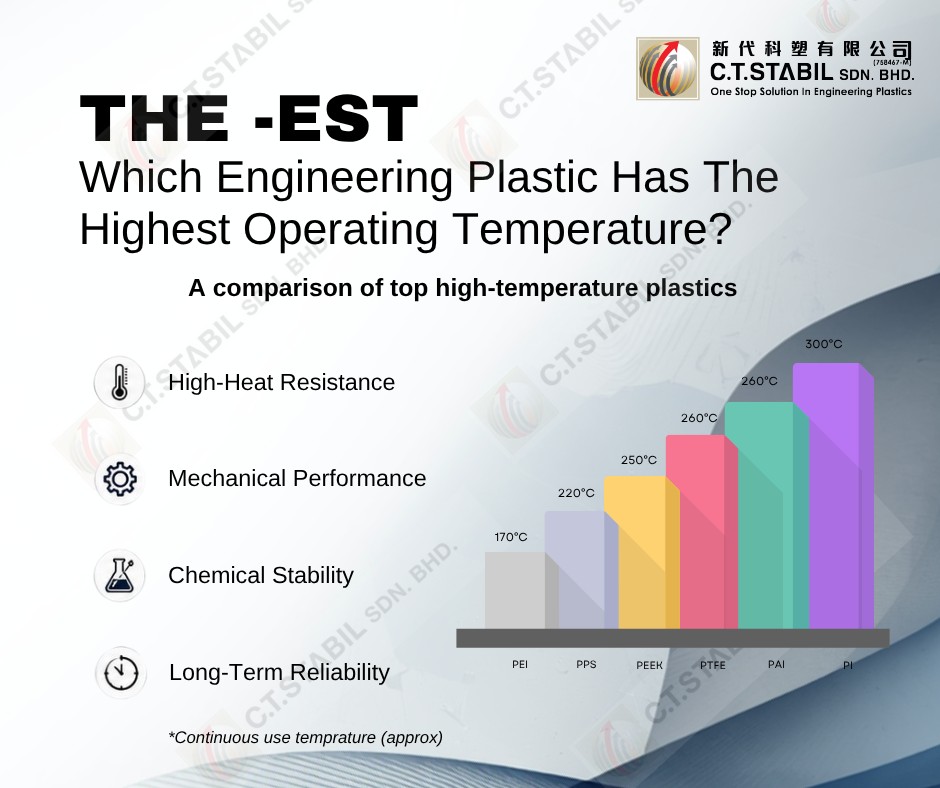
The table below compares several commonly used engineering plastics based on their approximate continuous operating temperatures.
| Material | Approximate Continuous Operating Temperature | Typical Applications |
| Polyimide (PI) | Up to 300°C | Aerospace, semiconductor, high-temperature bearings |
| PAI (Torlon®) | Up to 260°C | High-load bearings, gears, aerospace components |
| PEEK | Up to 250°C | Semiconductor, medical, oil & gas, food processing |
| PPS | Up to 220°C | Electrical components, pumps, valves, chemical processing |
| PEI (Ultem®) | Up to 170°C | Electrical insulation, medical devices, aerospace |
| PTFE | Up to 260°C (excellent chemically, lower mechanical strength) | Seals, gaskets, chemical processing |
| POM (Acetal) | Up to 100–120°C | Precision mechanical components |
| UHMW-PE | Up to 80–90°C | Wear strips, conveyor guides, liners |
Approximate values only. Actual operating temperatures depend on material grade, mechanical loading, operating environment, and application design.
Does a Higher Temperature Rating Always Mean a Better Material?
Not necessarily.
Although Polyimide (PI) offers one of the highest continuous operating temperatures among engineering plastics, it is also one of the most expensive and is generally reserved for highly specialised applications.
Likewise, PEEK can withstand temperatures approaching 250°C while maintaining excellent mechanical strength, making it a preferred choice for demanding industrial environments.
However, if an application only operates at 80°C, specifying PEEK may unnecessarily increase project costs when materials such as POM or UHMW-PE could perform perfectly well.
Selecting the highest-performing material is not always the most economical engineering solution.
Choosing the Right Material for High-Temperature Applications
Operating temperature is only one part of the material selection process.
Engineers should also evaluate:
- Mechanical load
- Chemical exposure
- Wear conditions
- Dimensional stability
- Electrical insulation requirements
- Food contact or regulatory compliance
- Machining requirements
- Overall project budget
For example, PPS offers an excellent balance of heat resistance, chemical resistance, and dimensional stability, making it a popular choice for pump components and electrical applications.
PEEK, on the other hand, is often selected when high temperatures are combined with demanding mechanical loads.
Meanwhile, PTFE excels in chemically aggressive environments but is generally chosen for its outstanding chemical resistance and extremely low friction rather than mechanical strength.
Common High-Temperature Applications
High-performance engineering plastics are widely used in applications such as:
- Semiconductor manufacturing equipment
- Aerospace components
- Medical sterilisation equipment
- Chemical processing systems
- Oil & gas equipment
- Food processing machinery
- High-temperature bearings and bushings
- Electrical insulation systems
Each application places different demands on the material, which is why engineers consider multiple performance factors rather than temperature alone.
So, Which Engineering Plastic Has the Highest Operating Temperature?
If operating temperature is the only consideration, Polyimide (PI) generally offers the highest continuous operating temperature among commercially available engineering plastics.
However, in practical engineering applications, materials such as PEEK, PAI (Torlon®), and PPS are often selected because they provide a more balanced combination of heat resistance, mechanical strength, machinability, chemical resistance, and overall cost.
The “best” material is therefore not necessarily the one with the highest temperature rating, but the one that delivers the most appropriate combination of properties for the intended application.
Conclusion
High operating temperature is an important consideration when selecting engineering plastics, but it should never be evaluated in isolation.
The most successful engineering designs balance thermal performance with mechanical strength, chemical compatibility, wear resistance, dimensional stability, and cost.
At C.T. Stabil, we help customers evaluate these factors to recommend the most suitable engineering plastic for their specific operating conditions rather than simply selecting the material with the highest temperature rating.
Continue Learning
Expand your knowledge with these related articles: