


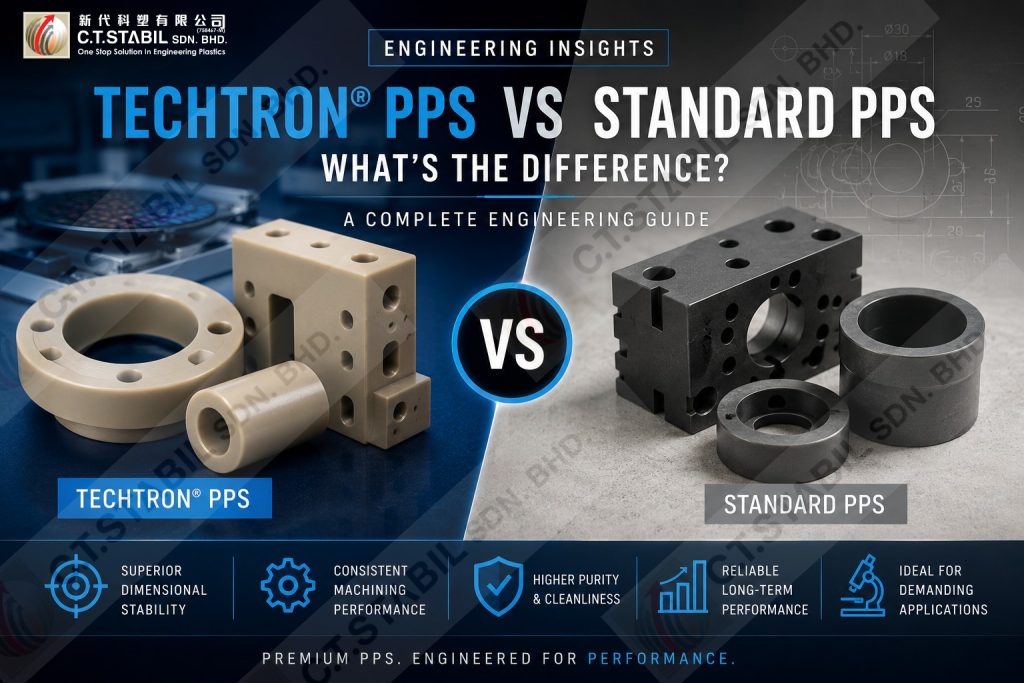
ENGINEERING INSIGHTS: Techtron® PPS vs Standard PPS – What’s the Difference?
⚡ Engineering Snapshot
- Techtron® PPS and standard PPS share the same polymer family, but manufacturing quality, process control, and material consistency can influence real-world engineering performance.
- Premium PPS grades such as Techtron® PPS are often selected for applications requiring high dimensional stability, consistent machining performance, and reliable long-term performance.
- Standard PPS remains an excellent engineering material for many industrial applications and may provide a practical solution where premium-grade characteristics are not essential.
- Selecting between Techtron® PPS and standard PPS should be based on application requirements, including operating environment, machining precision, quality consistency, and long-term reliability—not on brand name alone.
- The best engineering decision is rarely about choosing the highest specification; it is about selecting the material that delivers the right balance of performance, reliability, manufacturability, and overall engineering value.
18 – 20 minutes reading
Discover why not all PPS materials are created equal, and how selecting the right grade can improve reliability, precision, and long-term performance.
Introduction
When engineers or procurement teams specify Polyphenylene Sulfide (PPS) for a project, one common assumption is that all PPS materials offer identical performance because they share the same polymer family. While this assumption may seem reasonable, it overlooks one important reality: not all PPS materials are manufactured to the same standard.
Like many high-performance engineering plastics, the overall performance of PPS is influenced by much more than its chemical composition. Factors such as resin purity, compounding technology, manufacturing consistency, quality control, and traceability all contribute to how the finished material performs in real-world applications.
This becomes especially important in industries where dimensional accuracy, long service life, and production reliability are critical. A material that performs consistently over thousands of machining operations or production cycles often delivers greater value than one that simply offers similar properties on a datasheet.
Among the premium PPS materials available today, Techtron® PPS, manufactured by MCAM, has earned a strong reputation for its consistent quality, excellent machinability, and reliable performance across demanding industrial environments. While standard PPS materials can be suitable for many general-purpose applications, engineers frequently specify Techtron® PPS when consistency, precision, and long-term reliability are essential.
In this article, we’ll explore what distinguishes Techtron® PPS from standard PPS, why manufacturing quality matters, and how selecting the right PPS material can improve the performance and lifespan of your engineered components.
What is PPS (Polyphenylene Sulfide)?
Polyphenylene Sulfide, commonly known as PPS, is a semi-crystalline, high-performance engineering thermoplastic developed for applications that require exceptional thermal stability, chemical resistance, and dimensional precision.
Unlike many conventional engineering plastics, PPS retains its mechanical properties even when exposed to elevated temperatures, aggressive chemicals, and humid environments. This unique combination of characteristics has made PPS one of the preferred materials for precision components used in semiconductor manufacturing, electronics, chemical processing, automotive systems, and industrial machinery.
One of PPS’s most valuable characteristics is its extremely low moisture absorption. Unlike materials such as Nylon (PA), which absorb moisture and experience dimensional changes over time, PPS remains remarkably stable even in humid operating conditions. This makes it particularly suitable for precision-machined parts where tight tolerances must be maintained throughout the product’s service life.
In addition, PPS offers excellent natural flame resistance, outstanding electrical insulation properties, and broad chemical compatibility with acids, alkalis, solvents, and hydrocarbons. These characteristics allow PPS components to operate reliably in environments where metals may corrode and lower-grade plastics may soften or degrade.
Typical advantages of PPS include:
- Continuous operating temperatures of approximately 220°C, with the ability to withstand higher short-term temperature exposure depending on the application.
- Excellent resistance to a wide range of industrial chemicals and solvents.
- Very low moisture absorption for outstanding dimensional stability.
- High stiffness and mechanical strength over a broad temperature range.
- Inherent flame resistance without requiring halogen-containing flame retardants.
- Excellent electrical insulating properties.
- Good machinability for precision-engineered components.
Because of these properties, PPS has become a preferred material for manufacturing:
- Valve seats and valve components
- Pump housings and pump wear parts
- Electrical connectors
- Semiconductor fixtures
- Bearing cages
- Bushings
- Precision wear components
- High-temperature structural parts
However, while these performance characteristics describe PPS as a polymer family, they do not necessarily guarantee identical performance across every PPS product available on the market. The quality of raw materials, manufacturing processes, and quality assurance systems can significantly influence the consistency and reliability of the finished material.
This leads to an important question that many engineers overlook:
Is all PPS actually the same?
Is All PPS the Same?
At first glance, two PPS materials from different manufacturers may appear almost identical. Their datasheets often list similar tensile strength, operating temperature, density, and chemical resistance. This has led many buyers to believe that PPS is simply a commodity material where the lowest price should always win.
In reality, this is rarely the case.
While all PPS materials belong to the same polymer family, the final performance of a machined component depends on far more than the polymer itself. Differences in raw material quality, manufacturing processes, compounding expertise, and quality assurance can have a significant impact on how the material performs during machining and throughout its service life.
A useful comparison is stainless steel. Two manufacturers may both produce stainless steel that meets the same material specification, yet one may offer cleaner metallurgy, tighter dimensional tolerances, better surface finish, and more consistent mechanical properties. The same principle applies to engineering plastics.
For applications where reliability is critical, these differences become increasingly important.
What Makes One PPS Different from Another?
Several factors contribute to the quality and consistency of PPS materials.
1. Raw Material Quality
The quality of the base PPS resin is the foundation of the finished material.
Premium manufacturers carefully control resin purity and molecular consistency to produce materials with predictable mechanical and thermal properties. Lower-cost alternatives may meet basic specifications but can exhibit greater variation from batch to batch.
For engineers, consistent raw material quality translates into more predictable machining behaviour and more reliable component performance.
2. Manufacturing and Compounding Technology
Producing high-performance PPS involves much more than simply melting and shaping plastic.
The manufacturing process must carefully control temperature, pressure, cooling rate, and material distribution throughout the extrusion or compression process. Even small variations can introduce internal stresses or inconsistencies that may only become apparent during machining or long-term service.
Premium manufacturers also invest heavily in compounding technology to ensure fillers, lubricants, and reinforcing materials are evenly dispersed throughout the polymer matrix.
The result is a material that behaves consistently throughout the entire sheet or rod, reducing unexpected variations during production.
3. Dimensional Stability
For precision-machined components, dimensional stability is often more valuable than maximum mechanical strength.
Materials with poor internal stress control may deform after machining or gradually change shape during operation, particularly when exposed to elevated temperatures.
High-quality PPS materials are engineered to minimise these effects, allowing finished parts to maintain tight tolerances throughout their service life.
This is especially important in industries such as:
- Semiconductor manufacturing
- Precision automation
- Electronics assembly
- Chemical processing equipment
- Medical equipment
4. Machining Performance
Machine shops quickly recognise the difference between consistent and inconsistent engineering plastics.
Premium PPS materials generally provide:
- More stable machining performance
- Better dimensional repeatability
- Cleaner surface finishes
- Reduced risk of warping after machining
- Lower scrap rates during production
For manufacturers producing hundreds or thousands of precision components, these advantages can significantly improve productivity and reduce overall manufacturing costs.
5. Quality Control and Traceability
Another major difference lies in manufacturing quality systems.
Leading manufacturers implement rigorous inspection procedures throughout production, verifying dimensions, material properties, and production consistency before materials are released to customers.
Equally important is traceability.
For industries such as aerospace, semiconductor manufacturing, medical devices, and electronics, the ability to trace material batches back to their manufacturing records provides additional confidence in product quality and simplifies quality documentation when required.
Where Does Techtron® PPS Fit?
This is where premium materials such as Techtron® PPS, manufactured by MCAM, distinguish themselves.
Rather than competing solely on basic material properties, Techtron® PPS is recognised for delivering consistent quality, reliable machining performance, and dependable dimensional stability across a wide range of demanding industrial applications.
Engineers specify Techtron® PPS not because standard PPS is inadequate, but because certain applications leave very little room for variation.
When production downtime, precision tolerances, or long-term reliability are critical, consistency becomes a key engineering requirement—not simply a desirable feature.
By combining high-quality PPS resin, advanced manufacturing processes, stringent quality assurance, and global technical support, Techtron® PPS provides manufacturers with confidence that every sheet or rod performs as expected.
For many OEMs and precision component manufacturers, that confidence is often worth far more than the initial material cost difference.
Techtron® PPS vs Standard PPS at a Glance
Although all PPS materials share the same polymer family, selecting the right material involves more than comparing a few mechanical properties on a datasheet. Engineers must also consider manufacturing consistency, machining performance, quality assurance, and long-term reliability.
The following comparison highlights the practical differences that may influence material selection.
| Selection Criteria | Standard PPS | Techtron® PPS (MCAM) |
| Base Polymer | Polyphenylene Sulphide (PPS) | Polyphenylene Sulphide (PPS) |
| Heat Resistance | Excellent | Excellent |
| Chemical Resistance | Excellent | Excellent |
| Moisture Absorption | Very Low | Very Low |
| Electrical Insulation | Excellent | Excellent |
| Flame Resistance | Inherently flame retardant | Inherently flame retardant |
| Material Consistency | Varies between manufacturers | Excellent batch-to-batch consistency |
| Dimensional Stability | Good to Excellent, depending on manufacturer | Engineered for highly consistent dimensional stability |
| Internal Quality Control | Manufacturer dependent | Comprehensive manufacturing quality assurance |
| Material Traceability | May be limited | Strong product traceability and documentation |
| Machining Performance | Good | Optimised for precision machining with consistent results |
| Product Range | Varies | Broad range of specialised engineering grades |
| Global Technical Support | Depends on supplier | Backed by MCAM’s global engineering expertise |
| Recommended Applications | General industrial components | Precision engineering and demanding industrial applications |
Table 1: Practical comparison between standard PPS materials and Techtron® PPS.
Looking Beyond the Datasheet
One of the most common mistakes when selecting engineering plastics is focusing only on numerical values such as tensile strength, flexural modulus, or maximum operating temperature.
While these specifications are important, they rarely tell the complete story.
For example, two PPS materials may publish nearly identical mechanical properties, yet perform differently during machining or after months of continuous operation. Factors such as internal stress, manufacturing consistency, and dimensional stability often become evident only after the component has been installed in service.
This is why experienced engineers frequently evaluate materials using a broader perspective that includes:
- Consistency between production batches.
- Ease of machining and dimensional repeatability.
- Availability of technical documentation.
- Material traceability for quality management.
- Long-term reliability in demanding environments.
- Technical support from the material manufacturer and distributor.
When viewed from this broader engineering perspective, the value of a premium PPS material extends beyond the datasheet.
Why Consistency Matters in Real Manufacturing
Imagine a machine shop producing 500 precision valve seats from PPS rod.
If each rod behaves slightly differently during machining due to variations in internal stress or material consistency, operators may need to adjust machining parameters, inspect more frequently, or even reject parts that fall outside tolerance.
Although each individual variation may appear small, the cumulative impact can include:
- Increased machining time.
- Higher scrap rates.
- Additional inspection costs.
- Production delays.
- Reduced confidence in finished components.
Conversely, a material with consistent machining characteristics allows manufacturers to maintain stable production processes, reduce variability, and achieve predictable results from one production batch to the next.
For this reason, many manufacturers view material consistency not as a premium feature, but as an important contributor to manufacturing efficiency and overall product quality.
Why Engineers Choose Techtron® PPS for Critical Applications
In many industrial applications, selecting an engineering plastic is not simply about finding a material with the highest mechanical strength or temperature resistance. Instead, engineers must balance multiple factors, including dimensional stability, chemical compatibility, machining precision, service life, and production consistency.
This is where premium materials such as Techtron® PPS often become the preferred choice.
Rather than replacing every standard PPS application, Techtron® PPS is commonly selected for components where consistent performance and long-term reliability are essential.
Below are several examples that illustrate why.
1. Semiconductor Equipment
The semiconductor industry demands exceptional precision.
Components such as wafer handling fixtures, inspection equipment, vacuum chamber parts, and precision guides often operate under tightly controlled conditions where even minor dimensional changes can affect production accuracy.
Because PPS offers excellent dimensional stability, low moisture absorption, and resistance to elevated temperatures, it is widely used throughout semiconductor manufacturing equipment.
When consistency from one machined component to the next is equally important, engineers often specify premium PPS materials to help ensure predictable manufacturing results and repeatable performance throughout the equipment’s service life.
Typical semiconductor applications include:
- Wafer handling components
- Precision positioning guides
- Vacuum-compatible structural parts
- Test fixtures
- Inspection equipment components
2. Chemical Processing Equipment
Chemical processing environments expose materials to aggressive chemicals, elevated temperatures, and continuous operation.
Traditional metals may corrode under these conditions, while lower-performance plastics may soften, swell, or lose mechanical strength.
PPS is well known for its excellent resistance to a wide range of industrial chemicals, making it a preferred material for many fluid handling applications.
Engineers commonly specify premium PPS materials for:
- Pump wear rings
- Valve seats
- Valve discs
- Seal retainers
- Flow control components
- Chemical handling equipment
For these applications, reliable dimensional stability helps maintain sealing performance and reduces the risk of unexpected equipment downtime.
3. Precision Machined Components
Many engineering plastics perform well as moulded products but present challenges during precision machining.
Internal stresses, inconsistent material structure, or dimensional movement after machining can increase production costs and reduce component accuracy.
Manufacturers producing tight-tolerance components therefore place significant importance on material consistency.
Applications include:
- Precision bushings
- Bearing cages
- Wear pads
- Guide rails
- Positioning blocks
- Machine tooling components
Using a material with predictable machining characteristics enables manufacturers to reduce scrap, minimise machining adjustments, and achieve repeatable production quality.
4. Electrical and Electronic Systems
PPS has long been recognised for its excellent electrical insulation properties and inherent flame resistance.
Combined with its ability to withstand elevated operating temperatures, it is frequently selected for components used in demanding electrical environments.
Typical applications include:
- Electrical connectors
- Insulating components
- Switchgear parts
- High-temperature electrical fixtures
- PCB manufacturing equipment
- SMT production fixtures
For manufacturers operating high-volume production lines, consistent material quality helps maintain reliable assembly processes and product performance.
5. Industrial Automation and Machinery
Modern automated production systems rely heavily on lightweight, corrosion-resistant, and dimensionally stable engineering plastics.
Many moving components operate continuously for thousands of hours under varying temperatures and mechanical loads.
PPS provides an attractive combination of stiffness, thermal stability, and wear resistance that makes it suitable for many automation applications.
Examples include:
- Conveyor guide components
- Timing system components
- Wear strips
- Sliding guides
- Rollers
- Positioning mechanisms
For equipment manufacturers supplying machinery worldwide, selecting materials with dependable quality and global availability simplifies future maintenance and replacement.
Engineering Decisions Go Beyond Material Properties
Selecting an engineering plastic should never be based solely on a single property such as tensile strength or maximum operating temperature.
Instead, experienced engineers evaluate how the material will perform throughout the entire product lifecycle.
Important considerations include:
- Will the material machine consistently?
- Can tight tolerances be maintained?
- Will the component remain dimensionally stable after prolonged service?
- Is technical documentation available when required?
- Can replacement material be sourced consistently in the future?
These practical considerations often have a greater impact on overall equipment reliability than small differences in laboratory test results.
This is one of the reasons why many OEMs and precision manufacturers choose premium engineering materials such as Techtron® PPS for applications where reliability, repeatability, and manufacturing consistency are critical to long-term success.
When Should You Choose Standard PPS, and When Should You Upgrade to Techtron® PPS?
Choosing the right PPS material is not about identifying the “best” material—it is about selecting the most appropriate material for your specific application.
Both standard PPS and premium PPS materials such as Techtron® PPS have their place in modern engineering. The decision should be based on factors such as operating conditions, machining requirements, expected service life, regulatory requirements, and overall project objectives.
The following guidelines can help engineers and purchasing teams make a more informed material selection.
Standard PPS May Be the Right Choice If…
For many industrial applications, standard PPS provides an excellent balance between performance and cost.
It is often suitable when:
- Components operate under moderate mechanical loads.
- Dimensional tolerances are not extremely critical.
- Parts are relatively simple to machine.
- Production volumes are low or occasional.
- Budget is a primary consideration.
- The application does not require extensive material documentation or traceability.
Typical examples include:
- General machine components
- Electrical insulating parts
- Pump spacers
- Mounting brackets
- Structural supports
- Non-critical wear components
For these applications, standard PPS can deliver reliable performance while keeping material costs under control.
Consider Techtron® PPS When…
Some applications demand greater consistency and tighter process control.
Premium PPS materials such as Techtron® PPS are often preferred when:
- Tight machining tolerances must be maintained.
- Components are exposed to continuous high temperatures.
- Dimensional stability is critical throughout the product’s service life.
- Production involves large batches of precision-machined components.
- Material traceability or quality documentation is required.
- Equipment downtime would result in significant production losses.
- Long-term reliability is a key design consideration.
These requirements are common in industries such as:
- Semiconductor manufacturing
- Precision automation
- Electronics production
- Chemical processing
- Pharmaceutical equipment
- Food processing machinery
- OEM machinery manufacturing
In these environments, the additional consistency offered by a premium engineering material may contribute to lower manufacturing variability, improved component reliability, and reduced maintenance over the equipment’s operating life.
Material Selection Is More Than Comparing Prices
It is natural to compare engineering plastics based on material cost. However, the purchase price of the raw material represents only one part of the overall project cost.
When selecting a material, engineers should also consider:
- Machining efficiency
- Scrap and rework costs
- Equipment reliability
- Maintenance intervals
- Component replacement frequency
- Production downtime
- Product quality consistency
For example, if a premium PPS material reduces machining variability, lowers scrap rates, or extends component service life, the total cost of ownership may ultimately be lower than using a less consistent material.
Looking beyond the initial purchase price often leads to better long-term engineering decisions.
CT Stabil’s Engineering Recommendation
At CT Stabil, we understand that every engineering application is different.
Rather than recommending a single material for every project, we believe in selecting the material that best matches your technical requirements, operating environment, and budget.
The table below provides a general guide to material selection.
| Application Requirement | Recommended Approach |
| General industrial components | Standard PPS is often a practical and cost-effective solution. |
| Precision-machined parts | Consider a premium PPS such as Techtron® PPS for improved consistency and dimensional stability. |
| Semiconductor equipment | Premium PPS is commonly preferred where precision and repeatability are essential. |
| Chemical processing equipment | Selection should consider the specific chemicals, operating temperature, pressure, and service conditions. |
| High-volume production | Materials with consistent machining performance can help reduce production variability. |
| Cost-sensitive projects | Standard PPS may provide excellent value where application requirements allow. |
Every application presents unique engineering challenges. Material selection should therefore consider the complete operating environment rather than relying solely on individual datasheet values.
If you are unsure which PPS grade is most suitable for your application, consulting with an experienced engineering plastics supplier can help ensure the right balance of performance, reliability, and cost.
About CT Stabil Technical Publications
CT Stabil Technical Publications is an educational knowledge series developed to help engineers, designers, purchasers, and manufacturers better understand engineering plastics and make informed material selection decisions.
Each publication combines engineering principles, industry practices, manufacturer information, and practical application experience to provide balanced, objective, and technically focused guidance.
Our goal is not simply to introduce engineering materials, but to help readers understand why a material is selected, how it performs in real-world applications, and when it represents the most appropriate engineering solution.
Article Information
| Information | Details |
|---|
| Series | Engineering Insights |
| Publication No. | CTS-EI-001 |
| Article Title | Techtron® PPS vs Standard PPS – What’s the Difference? |
| Technical Level | Advanced |
| Estimated Reading Time | 18 min read |
| Published | July 2026 |
| Last Reviewed | July 2026 |
| Prepared by | CT Stabil Technical Publications |
| Technical Review | CT Stabil Engineering Team |
Technical Disclaimer
This publication is intended for educational and general engineering reference purposes only.
The information presented reflects commonly accepted engineering principles together with industry references available at the time of publication. Material properties, performance characteristics, and application suitability may vary depending on the manufacturer, material grade, processing method, operating environment, component design, and service conditions.
Readers should verify all technical information and consult the relevant manufacturer data before making engineering, design, or purchasing decisions.
Nothing contained in this publication should be interpreted as a substitute for professional engineering judgement or application-specific testing.
Copyright Notice
© 2026 CT Stabil Sdn. Bhd. All rights reserved.
This publication forms part of the CT Stabil Technical Publications series.
You may quote brief excerpts from this publication for educational or editorial purposes provided appropriate attribution is given to CT Stabil Sdn. Bhd.
Reproduction, republication, or redistribution of this publication in whole or in substantial part without prior written permission is prohibited.
References & Further Reading
The technical information presented in this publication has been prepared with reference to industry literature, manufacturer technical documentation, engineering handbooks, and recognised engineering practices, including:
- Manufacturer technical data for commercially available PEEK and PPS materials
- Material property information published by leading engineering plastics manufacturers
- ASTM International standards relating to plastics testing and material characterisation
- ISO standards relevant to engineering plastics
- Engineering reference handbooks covering high-performance thermoplastics
- Practical application knowledge and technical experience from CT Stabil Engineering Team