


What Is PEEK? Properties, Applications and Benefits
5 – 6 minutes reading.
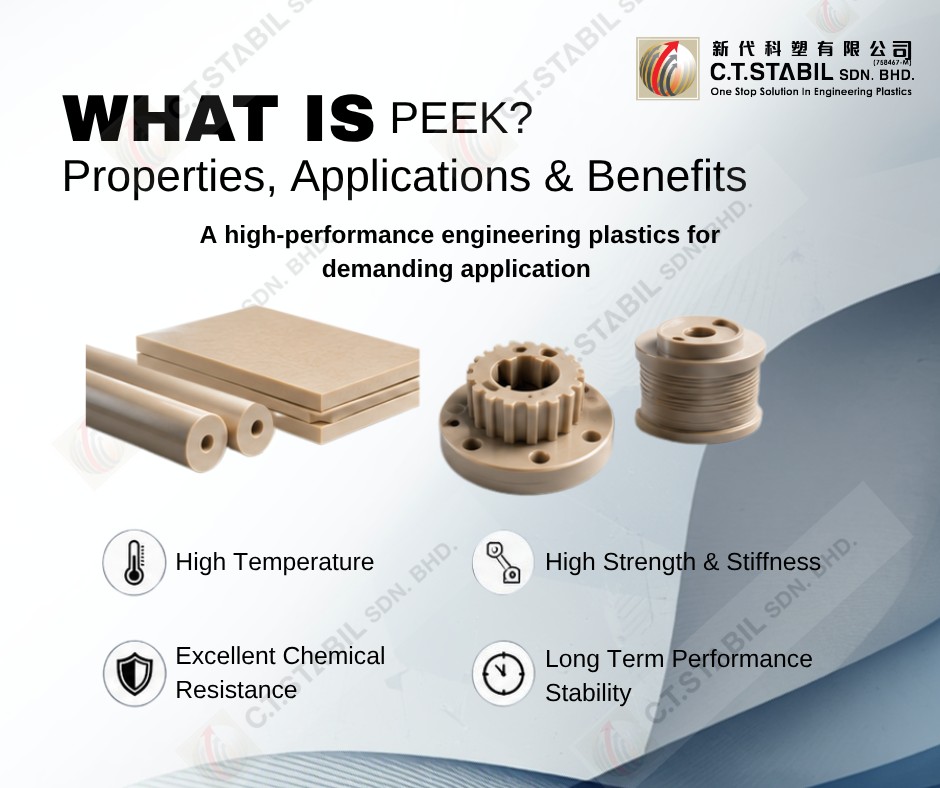
Polyether Ether Ketone (PEEK) is one of the world’s most advanced high-performance engineering thermoplastics. Renowned for its exceptional mechanical strength, outstanding heat resistance, and excellent chemical resistance, PEEK has become the material of choice for demanding applications where conventional engineering plastics and even some metals are unable to perform reliably.
Today, PEEK is widely used across industries such as aerospace, semiconductor manufacturing, medical devices, oil and gas, food processing, and precision engineering. Its unique combination of durability and lightweight properties enables engineers to design components that operate reliably in harsh environments while reducing maintenance and improving equipment performance.
What Is PEEK?
PEEK belongs to the polyaryletherketone (PAEK) family of semi-crystalline thermoplastics. It was developed to provide outstanding performance in applications involving high temperatures, heavy mechanical loads, aggressive chemicals, and continuous operation.
Unlike many engineering plastics, PEEK retains its strength and stiffness even at elevated temperatures, making it suitable for applications where dimensional stability and long-term reliability are critical.
In many industries, PEEK is also selected as a lightweight alternative to metals such as aluminium, stainless steel, and bronze, helping reduce component weight without compromising performance.
Key Properties of PEEK
PEEK is recognised for its impressive combination of physical, mechanical, and thermal properties.
Some of its key advantages include:
- Excellent continuous operating temperature of up to approximately 250°C
- Outstanding mechanical strength and stiffness
- Excellent wear and abrasion resistance
- Very low moisture absorption
- Excellent resistance to a wide range of chemicals
- Good dimensional stability during long-term operation
- Excellent electrical insulating properties
- Inherent flame resistance with low smoke emission
- Suitable for precision machining into complex components
These properties allow PEEK to perform reliably in some of the world’s most demanding industrial environments.
Common Applications of PEEK
Because of its outstanding performance, PEEK is used in numerous high-value engineering applications.
Semiconductor Industry
PEEK is commonly used for:
- Wafer handling components
- Test sockets
- Precision fixtures
- Insulating components
Its dimensional stability and low contamination characteristics make it suitable for precision manufacturing environments.
Aerospace Industry
Aircraft manufacturers utilise PEEK for components that require high strength while reducing overall weight.
Typical applications include:
- Structural brackets
- Cable insulation
- Bearing components
- Aircraft interior parts
Medical Industry
Medical-grade PEEK is widely used because it offers excellent biocompatibility and can withstand repeated sterilisation processes.
Examples include:
- Surgical instruments
- Orthopaedic implants
- Dental components
- Medical device housings
Oil & Gas Industry
PEEK performs well under demanding operating conditions involving high temperatures and aggressive chemicals.
Applications include:
- Valve seats
- Compressor components
- Sealing systems
- Pump wear parts
Industrial Machinery
Engineers frequently machine PEEK into precision components such as:
- Bearings
- Bushings
- Wear pads
- Gears
- Rollers
- Guide components
These parts often benefit from reduced weight, corrosion resistance, and long service life.
Why Do Engineers Choose PEEK?
Selecting an engineering plastic involves more than simply comparing strength or temperature ratings.
Engineers often choose PEEK because it offers an exceptional balance of properties that few other materials can match.
Compared with many conventional engineering plastics, PEEK can operate at higher temperatures while maintaining excellent mechanical performance. It also offers superior resistance to chemicals and moisture, making it suitable for applications where reliability is essential.
In addition, PEEK’s excellent machinability allows manufacturers to produce complex precision components with tight tolerances, making it a popular choice for custom-engineered parts.
Is PEEK the Right Material for Every Application?
Although PEEK offers exceptional performance, it is not always the most appropriate material.
For many applications, materials such as POM (Acetal), PET, PEI, PPS, or UHMW-PE may provide sufficient performance at a lower material cost.
The best material depends on factors such as:
- Operating temperature
- Mechanical loading
- Chemical exposure
- Dimensional tolerance requirements
- Wear conditions
- Budget
Carefully evaluating these requirements helps ensure the most cost-effective material selection.
Conclusion
PEEK has earned its reputation as one of the world’s leading high-performance engineering plastics. Its exceptional heat resistance, mechanical strength, chemical resistance, and dimensional stability make it an excellent solution for demanding industrial applications across a wide range of industries.
However, selecting the right engineering plastic is not about choosing the highest-performing material—it is about choosing the material that best matches your application’s technical and commercial requirements.
At C.T. Stabil, we supply a comprehensive range of high-performance engineering plastics and work closely with customers to recommend the most suitable material for their specific applications.
Continue Learning
Interested in learning more about engineering plastics? Explore our related technical articles:
- Engineering Insights: Techtron® PPS vs Standard PPS – What’s the Difference?
- Why Is UHMW-PE So Wear Resistant?
- How to Choose Between POM-C and POM-H
- Which Engineering Plastic Has the Highest Operating Temperature?