


What Are G10 and FR4? Properties, Applications and Differences
What Is? • Beginner • 5 min read
⭐ Material Snapshot
Material Family: Glass-cloth reinforced epoxy thermoset laminate
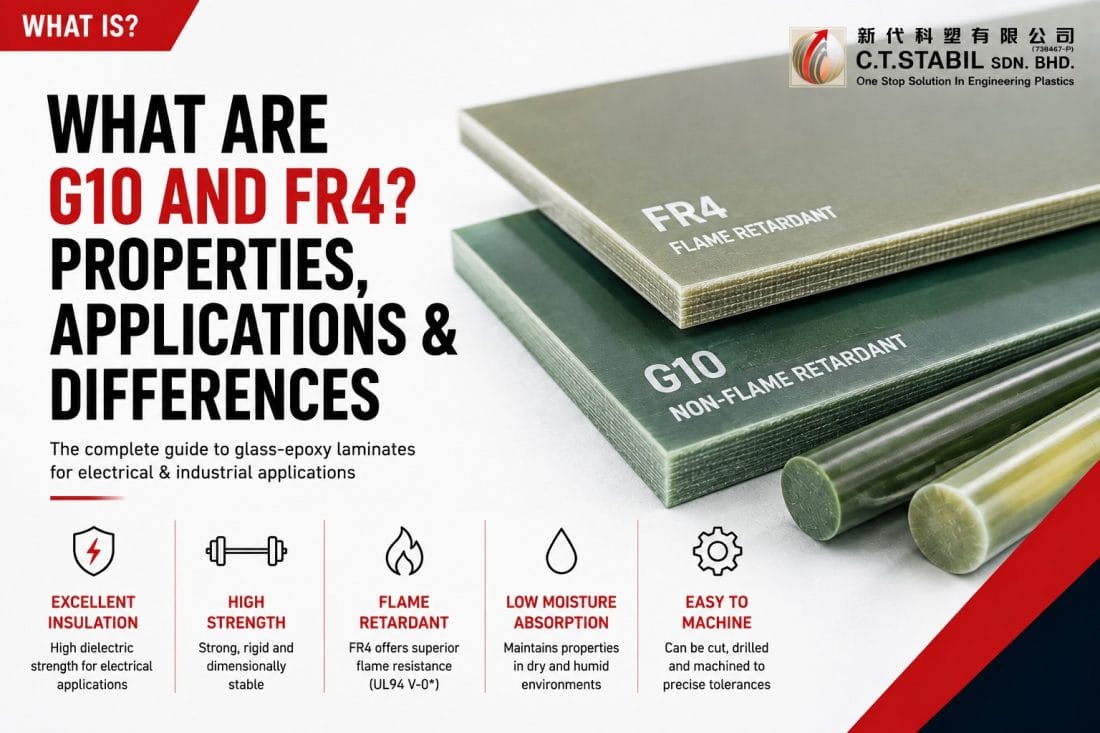
Common Appearance: Natural green, yellow-green or similar shades depending on grade and manufacturer
Key Strengths:
- High mechanical strength
- Excellent electrical insulation
- Good dimensional stability
- Low moisture absorption
- Good chemical resistance
- Excellent machinability for many industrial components
Typical Applications:
Electrical insulation • Busbar supports • Terminal boards • Structural components • Industrial fixtures • Electronics and electrical equipment
Introduction
G10 and FR4 are two names frequently encountered when engineers purchase glass-fibre reinforced epoxy laminate.
They are strong, rigid, electrically insulating materials used extensively in electrical, electronic and industrial applications. However, they are also the source of considerable confusion—particularly when customers see both materials offered in similar green-coloured sheets and are told that they are “the same thing.”
The reality is more nuanced.
G10 and FR4 are closely related glass-cloth/epoxy laminate materials, but the designation and performance requirements are not necessarily identical. In particular, flame-retardant performance is an important distinction when selecting FR4 for an application. IEC 60893 provides formal classifications and requirements for rigid laminated electrical insulating materials based on thermosetting resins, including epoxy-resin systems reinforced with materials such as glass cloth.
So, what exactly are G10 and FR4?
What Is G10?
G10 is a glass-cloth reinforced epoxy laminate manufactured by impregnating layers of woven glass fabric with epoxy resin and consolidating them under heat and pressure.
The resulting laminate is rigid, strong and electrically insulating. Its combination of mechanical strength and electrical performance makes it suitable for applications where a conventional thermoplastic would not provide the required stiffness or insulation.
Typical applications include:
- Electrical insulation components
- Terminal boards
- Insulating supports
- Structural electrical components
- Mechanical fixtures
- Precision-machined insulating parts
G10 is particularly valued where engineers require a material that combines high rigidity with electrical insulation.
What Is FR4?
FR4 is also a glass-cloth reinforced epoxy laminate, but the designation is associated with a flame-retardant grade of glass-epoxy laminate.
This makes FR4 especially important in electrical and electronic applications where resistance to ignition and flame propagation is part of the material requirement.
Commercial FR4 materials are commonly manufactured using woven glass fabric and an epoxy resin system formulated to achieve the required electrical, mechanical and flammability characteristics. Manufacturer data can specify additional requirements such as UL recognition or compliance with particular material standards, so the exact grade should always be checked against its technical documentation.
This is why FR4 is widely associated with electrical insulation and printed-circuit-board applications, although industrial FR4 laminates are also available in thicker forms for machined components and structural insulation.
So, What Is the Difference Between G10 and FR4?
This is where the confusion usually begins.
Both materials can have:
- Glass-cloth reinforcement
- Epoxy resin binder
- High mechanical strength
- Excellent electrical insulation
- Good dimensional stability
- Similar physical appearance
Commercial suppliers may even describe products as “G10/FR4”, reflecting how closely related these laminate grades can be.
However, FR4 is specifically associated with flame-retardant performance, whereas G10 is generally used to describe the corresponding glass-epoxy laminate without making the same flame-retardancy claim.
Therefore, they should not automatically be treated as interchangeable.
If an application has a specific flammability requirement, simply substituting a material called “G10” because it looks identical may not satisfy the required specification.
Why Are G10 and FR4 Often Confused in the Market?
This is particularly relevant to customers purchasing engineering materials in Malaysia.
In everyday industrial conversations, “G10” is sometimes used as a general name for the green glass-epoxy laminate, even when the actual material being supplied may be an FR4-grade product.
The colour contributes to the confusion.
Many commercially available glass-epoxy laminates have a natural green or yellow-green appearance, but colour does not determine the material grade. Manufacturer data, certification and material designation are much more reliable ways to identify the product.
This is an important point for purchasing and engineering teams:
Do not identify G10 or FR4 by colour alone. Identify the material by its specification.
If a drawing, customer specification or application requires FR4, the supplier should be able to provide the relevant technical documentation for the material being offered.
Can G10 Replace FR4?
Not automatically.
If the application only requires the mechanical and electrical characteristics of a glass-epoxy laminate and does not have a specific flame-retardancy requirement, a suitable G10-type material may potentially be considered.
However, where flame performance, certification, regulatory compliance or a specific material standard is required, the proposed replacement must be verified against those requirements.
The same principle applies in reverse.
FR4 may be suitable as a replacement for G10 in some applications, but “FR4” should not be treated as a universal upgrade.
The correct material depends on what the component actually needs to do.
Where Are G10 and FR4 Used?
G10 and FR4 can be found in a wide range of applications involving electrical insulation, mechanical strength and dimensional stability.
Typical examples include:
- Electrical insulating components
- Terminal strips and boards
- Busbar supports
- Transformer and motor insulation components
- Electronic equipment
- PCB-related applications
- Insulating washers and spacers
- Machined electrical fixtures
- Structural components requiring electrical isolation
Their combination of glass reinforcement and epoxy resin provides a useful balance of rigidity, strength and insulation that makes them difficult to replace with ordinary plastics in certain applications.
How Should You Choose Between G10 and FR4?
Start with the application requirements rather than the material name.
Ask:
- Is electrical insulation required?
- Is mechanical strength or rigidity important?
- Is flame-retardant performance required?
- Does the application have a specific certification or standard?
- Will the material be machined into a precision component?
- Does the customer drawing specify G10, FR4 or another recognised designation?
For critical applications, the manufacturer’s datasheet and applicable certification should always be checked before substituting one grade for another. IEC itself emphasises that material selection should be based on the actual performance requirements of the application rather than the material designation alone.
Conclusion
G10 and FR4 are closely related glass-cloth reinforced epoxy laminates with excellent mechanical and electrical properties.
The most important distinction is that FR4 is associated with flame-retardant performance, while G10 is generally used for the corresponding glass-epoxy laminate without that specific flame-retardant designation.
In the Malaysian market, the two names are often used loosely, and their similar green appearance can make the confusion even greater.
The safest approach is simple:
Don’t select G10 or FR4 based on colour or common market terminology. Select it based on the actual material specification and the requirements of the application.
For engineers and purchasers, understanding this distinction can prevent an apparently simple material substitution from becoming a much bigger problem later.
At C.T. Stabil, we believe the best engineering plastic is not necessarily the one with the highest specifications—it is the one that delivers the right balance of performance, reliability, manufacturability, and engineering value for the intended application.
Whether you are designing new equipment or replacing an existing component, understanding the capabilities of PPS is the first step towards making informed engineering decisions.
Continue Learning
Interested in expanding your knowledge of engineering plastics? Continue with these related technical publications:
- What Is PEEK? Properties, Applications and Benefits
- Why Is UHMW-PE So Wear Resistant?
- What is Ertalyte™PET-P — and how does it differ from other PET brands?
- Which Engineering Plastic Has the Highest Operating Temperature?
- Techtron® PPS vs Standard PPS: What’s the Difference?
- PEEK vs PPS: Which High-Performance Engineering Plastic Should You Choose?
About CT Stabil Technical Publications
C.T. Stabil Technical Publications is a knowledge series created to help engineers, designers, purchasers, and manufacturers better understand engineering plastics and make informed material selection decisions.
Our publications combine engineering principles, recognised industry practices, manufacturer technical information, and practical application experience to deliver objective, educational, and application-focused content.
Our mission is to simplify complex material selection decisions while promoting sound engineering practices across a wide range of industrial applications.
Article Information
| Information | Details |
| Series | What Is? |
| Publication No. | CTS-WI-005 |
| Article Title | What Is PPS? Properties, Applications and Benefits |
| Technical Level | Beginner |
| Estimated Reading Time | 6 -7 min read |
| Published | July 2026 |
| Last Reviewed | July 2026 |
| Prepared by | C.T. Stabil Technical Publications |
| Technical Review | C.T. Stabil Engineering Team |
Technical Disclaimer
This publication is intended for educational and general engineering reference purposes only.
The information presented reflects commonly accepted engineering principles together with industry references available at the time of publication. Material properties, performance characteristics, and application suitability may vary depending on the manufacturer, material grade, processing methods, operating conditions, component design, and service environment.
Readers should verify all technical information and consult the relevant manufacturer’s technical documentation before making engineering, design, or purchasing decisions.
Nothing contained in this publication should be interpreted as a substitute for professional engineering judgement or application-specific testing.
Copyright Notice
© 2026 CT Stabil Sdn. Bhd. All rights reserved.
This publication forms part of the C.T. Stabil Technical Publications series.
You may quote brief excerpts from this publication for educational or editorial purposes provided appropriate attribution is given to CT Stabil Sdn. Bhd.
Reproduction, republication, or redistribution of this publication in whole or in substantial part without prior written permission is prohibited.
References & Further Reading
The information presented in this publication has been prepared with reference to recognised engineering resources, including:
- Manufacturer technical data for commercially available PPS materials
- Material property information published by leading engineering plastics manufacturers
- ASTM International standards relating to plastics testing and material characterisation
- ISO standards relevant to engineering plastics
- Engineering plastics reference handbooks
- Practical engineering knowledge and application experience from the C.T. Stabil Engineering Team