


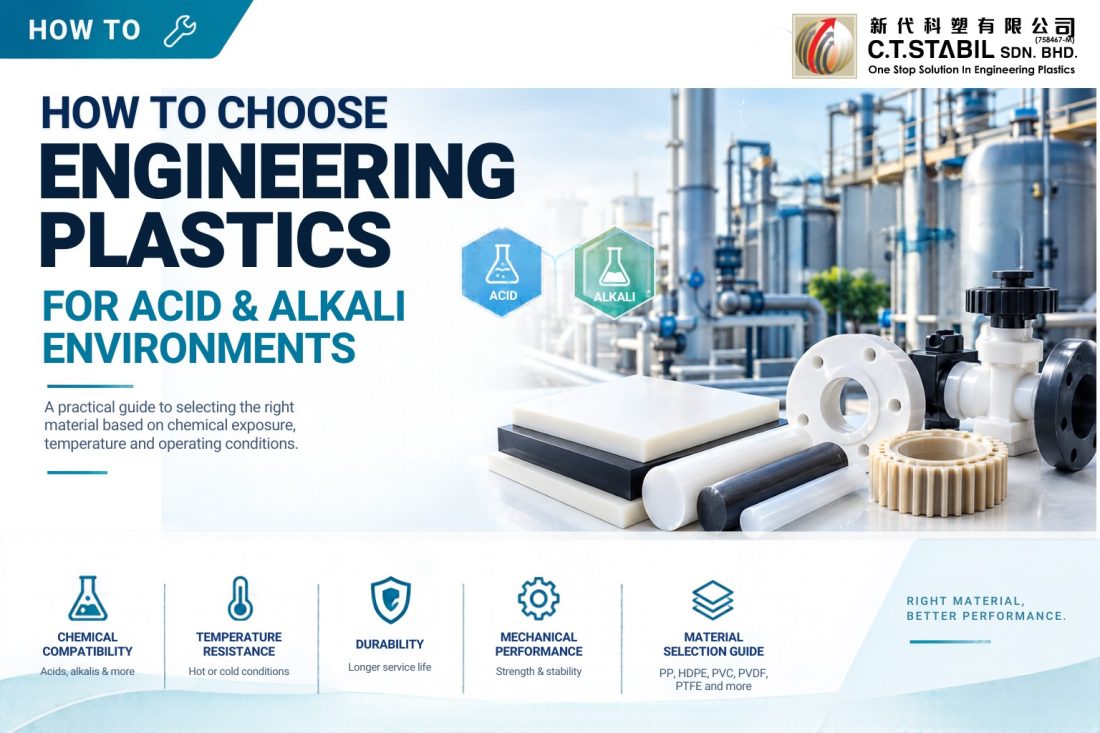
How to Choose Engineering Plastics for Acid and Alkali Environments?
Knowledge Center | Why Is? Series
7 to 8 minutes reading time
Introduction
Selecting the right engineering plastic for chemical exposure is essential for reliable performance, reduced maintenance and longer component service life. In industries such as chemical processing, water treatment, semiconductor manufacturing and industrial equipment, plastic sheets, rods, pipes, valves and machined components may be exposed to acids, alkalis, cleaning agents and other aggressive chemicals.
However, no single plastic is suitable for every chemical environment. A material that performs well in dilute acid at room temperature may not withstand a concentrated chemical at elevated temperatures. Mechanical stress, exposure duration and the specific material grade can also affect performance.
So, how do you choose the right engineering plastic for acid and alkali environments?
The best approach is to identify the operating conditions, compare the properties of suitable materials and verify chemical compatibility using reliable technical data before making a final selection.
1. Understand the Chemical Exposure Conditions
Before comparing plastics, establish exactly what the component will encounter and how it will operate.
Chemical type and concentration
Different acids and alkalis interact differently with polymers. Dilute hydrochloric acid, concentrated sulphuric acid and nitric acid present different compatibility requirements. The same applies to sodium hydroxide and potassium hydroxide solutions at different concentrations.
Chemical mixtures, impurities and cleaning agents can further affect compatibility.
Operating temperature
Chemical resistance can change significantly with temperature. A plastic suitable for a chemical at room temperature may not be suitable at a higher operating temperature.
Exposure duration
Occasional splashes, intermittent cleaning and continuous immersion create different conditions. Long-term exposure can lead to swelling, cracking, embrittlement or a reduction in mechanical properties.
Mechanical stress and operating pressure
A chemically compatible material may still fail if it is under excessive stress. Pressure, sustained loading, vibration, thermal cycling and residual stress from machining can influence the performance of the finished component.
These factors should be established before selecting a material.
2. Compare Common Engineering Plastics
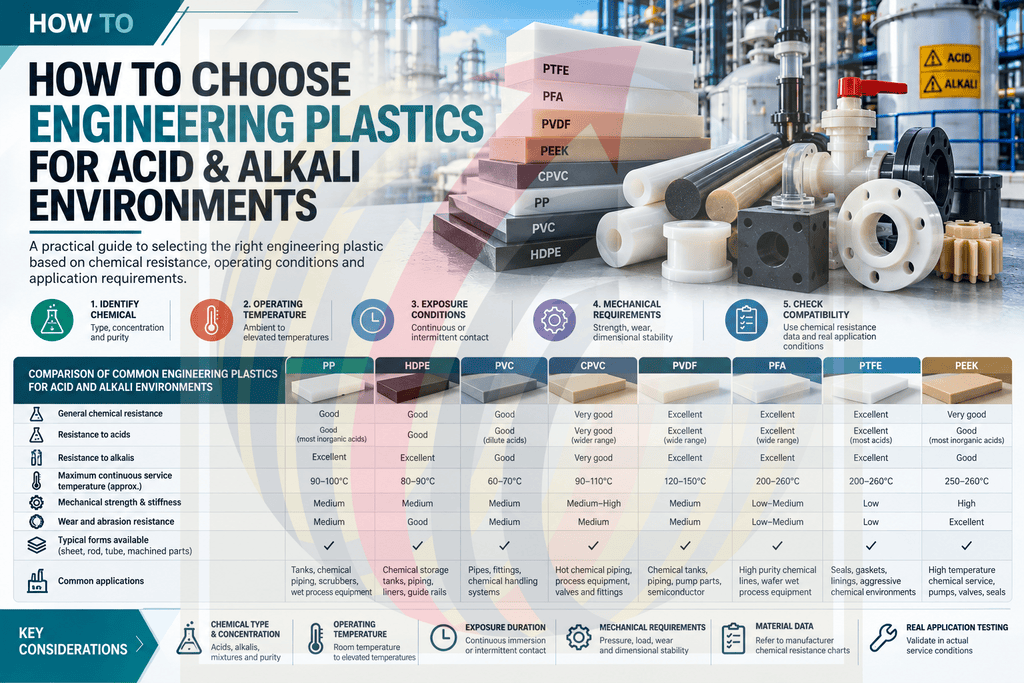
The following table provides a preliminary guide to eight materials commonly considered for chemical-handling applications. The descriptions are general screening guidance, not universal chemical-resistance ratings.
| Material | General characteristics | Important selection considerations |
|---|---|---|
| PP — Polypropylene | Often suitable for many aqueous acids and alkalis; economical and lightweight | Check strong oxidising acids, concentration, temperature and mechanical loading |
| HDPE — High-Density Polyethylene | Good resistance to many aqueous acids and alkalis; useful impact resistance | Consider operating temperature, permeation, stiffness and long-term loading |
| PVC — Polyvinyl Chloride | Widely used in chemical piping, fittings and fluid-handling systems | Verify chemical compatibility, temperature limits and suitability for solvents |
| CPVC — Chlorinated Polyvinyl Chloride | Offers higher temperature capability than conventional PVC in suitable piping systems | Check the exact chemical, concentration, temperature and pressure rating |
| PVDF — Polyvinylidene Fluoride | Broad chemical resistance and useful performance in demanding chemical environments | Hot alkalis and mechanical stress require particular attention |
| PFA — Perfluoroalkoxy | Very broad chemical resistance and high-purity applications; available in suitable tubing, linings and components | Consider temperature, permeation, mechanical loading and component design |
| PTFE — Polytetrafluoroethylene | Exceptional resistance to a very wide range of chemicals | Consider creep, cold flow, sealing loads and dimensional requirements |
| PEEK — Polyether Ether Ketone | High mechanical strength, stiffness, wear resistance and useful chemical resistance | Not resistant to every strong acid or aggressive chemical; confirm the exact exposure conditions |
The key differences are not simply chemical resistance. CPVC can be attractive for chemical piping where temperature capability matters; PFA and PTFE are often considered for particularly demanding chemical exposure; and PEEK can be useful where mechanical performance and chemical resistance are both important.
For more general-purpose applications, PP and HDPE may provide an economical solution. PVC and CPVC are often considered for fluid-handling systems, subject to their respective operating limits.
3. Selecting Plastics for Acid Environments
Acids vary considerably in their effects on plastics. Some materials perform well in dilute aqueous acids but become unsuitable as concentration or temperature increases.
PP and HDPE are common candidates for many aqueous acid applications under suitable conditions. PVC and CPVC may also be suitable for many acid-handling piping systems, depending on the chemical and operating limits.
PVDF, PFA and PTFE are worth evaluating for demanding chemical services because of their broad chemical resistance. PFA is particularly relevant in applications requiring high chemical purity or suitable fluoropolymer linings and fluid-contact components.
PEEK can provide a useful combination of chemical resistance and mechanical strength. However, its compatibility depends on the specific acid. Certain concentrated or strongly oxidising acids may be unsuitable, so PEEK should not be selected based on its high-performance classification alone.
When selecting a plastic for acid exposure, confirm:
- The exact acid and concentration
- Normal and maximum operating temperatures
- Continuous or intermittent exposure
- Mechanical stress, pressure and possible abrasion
- The compatibility rating for the specific material grade
Never assume that resistance to one acid guarantees resistance to another.
4. Selecting Plastics for Alkali Environments
Alkalis such as sodium hydroxide and potassium hydroxide are widely used in industrial cleaning, water treatment and chemical processing.
PP and HDPE are often considered for many aqueous alkali applications. PVC and CPVC may be suitable for compatible chemical-handling systems, subject to temperature and pressure limitations.
PFA and PTFE offer broad chemical resistance and are often considered for more demanding services. PEEK can also be suitable for many alkalis while providing better mechanical performance than softer fluoropolymers in certain component designs.
However, strong or hot alkali solutions still require careful assessment. Some polymers and reinforced grades can experience chemical degradation or stress-related failure under particular conditions.
PVDF, for example, requires special attention in hot alkaline environments, particularly when mechanical stress is present.
Before selecting a material, verify the manufacturer’s compatibility data for the actual chemical concentration and temperature. If the application is critical, testing under representative service conditions may be necessary.
5. Choose the Material According to the Application
Chemical compatibility alone does not determine the best material. The component must also meet its mechanical, dimensional and operating requirements.
| Application requirement | Materials worth evaluating | Why they may be considered |
|---|---|---|
| General-purpose chemical tanks and components | PP, HDPE | Resistance to many aqueous chemicals and economical material options |
| Chemical piping and fittings | PVC, CPVC, PP, PVDF | Selection depends on chemical compatibility, temperature and pressure |
| Demanding chemical exposure or high-purity fluid handling | PFA, PTFE, PVDF | Broad chemical resistance; PFA and PTFE are often considered for high-purity applications |
| Precision machined components exposed to compatible chemicals | PEEK, PVDF, PTFE | Different combinations of chemical resistance, mechanical properties and dimensional requirements |
| Components requiring strength and wear resistance | PEEK | High stiffness, strength and wear performance, provided the chemical is compatible |
| Chemical-resistant linings, seals and fluid-contact parts | PFA, PTFE, PVDF | Potentially suitable depending on design, exposure and mechanical requirements |
These are starting points for material selection rather than definitive recommendations. For example, PEEK may be preferable when a component must carry a mechanical load, while PTFE may be preferable when broad chemical resistance is the dominant requirement and its mechanical limitations can be managed.
The correct choice depends on the component design and the actual operating conditions.
6. Consider Mechanical and Dimensional Requirements
A plastic component must continue to perform its intended function throughout its service life.
Consider the following factors when selecting a material:
- Mechanical strength: Can it withstand the applied load and operating pressure?
- Dimensional stability: Will it maintain the required dimensions?
- Wear resistance: Will contact with moving parts or abrasive particles cause premature wear?
- Creep resistance: Will sustained loading cause gradual deformation?
- Machinability: Can it be machined to the required tolerances and surface finish?
- Permeation: Can the chemical pass through the material at a rate that affects safety or performance?
- Fabrication method: Will welding, machining, lining or joining affect the finished component’s suitability?
PFA and PTFE offer broad chemical resistance but may require careful design where sustained mechanical loading or dimensional precision is important. PEEK offers strong mechanical performance, but its chemical compatibility must still be verified. CPVC and other piping materials must be assessed against the pressure and temperature requirements of the complete system.
The best material balances chemical compatibility, mechanical performance, fabrication requirements and total service-life cost.
7. Use Chemical Resistance Charts Correctly
Chemical resistance charts are valuable tools for narrowing down candidate materials, but their ratings must be interpreted carefully.
Before relying on a chart, confirm that it covers:
- The exact chemical or mixture
- The chemical concentration
- The operating temperature
- The exposure duration
- The material grade and formulation
- The mechanical conditions of the application
Also check whether the data applies to unfilled or reinforced material. Fillers, reinforcement, additives and manufacturing processes can influence performance.
For demanding or safety-critical applications, consult the material manufacturer and consider testing representative samples under realistic service conditions. A general chart should not replace an application-specific engineering assessment.
8. A Practical Material Selection Checklist
Before ordering engineering plastic for a chemical-handling application, confirm the following:
- Identify the exact chemical or mixture.
- Establish its concentration and operating temperature range.
- Define the exposure duration and frequency.
- Assess pressure, mechanical stress, wear and dimensional requirements.
- Shortlist materials such as PP, HDPE, PVC, CPVC, PVDF, PFA, PTFE and PEEK according to the application.
- Check the relevant manufacturer’s chemical compatibility data for the exact conditions.
- Consider fabrication, machining and joining requirements.
- Validate the final selection where failure could create safety, environmental or significant operational consequences.
Following this process helps reduce the risk of premature material failure, unplanned maintenance and unnecessary replacement costs.
Conclusion
Choosing engineering plastics for acid and alkali environments requires more than identifying a material with a reputation for chemical resistance. Chemical type, concentration, temperature, exposure duration, mechanical stress and the specific material grade all influence suitability.
PP, HDPE, PVC, CPVC, PVDF, PFA, PTFE and PEEK each offer different combinations of chemical resistance, mechanical performance, temperature capability and fabrication characteristics.
For general-purpose chemical handling, PP and HDPE may be suitable starting points. PVC and CPVC are often considered for compatible piping systems. PVDF, PFA and PTFE may be appropriate for more demanding chemical exposure, while PEEK can be useful when chemical compatibility must be combined with higher mechanical performance.
At C.T. Stabil Sdn Bhd, selecting the right engineering plastic begins with understanding the application. If you are choosing plastic sheets, rods or machined components for a chemical environment, establish the operating conditions and confirm compatibility with the relevant technical data before proceeding.
Technical note: This article provides general material-selection guidance. It is not a universal chemical compatibility chart or a substitute for manufacturer verification and application-specific engineering assessment.
Continue Learning
Interested in expanding your knowledge of engineering plastics? Continue with these related technical publications:
- How to Choose Between POM-C and POM-H?
- Engineering FAQ #001 – Why Are Plastic Parts Cracking After Machining?
- What Are G10 and FR4? Properties, Applications and Differences
- Which Engineering Plastic Has the Highest Operating Temperature?
- Techtron® PPS vs Standard PPS: What’s the Difference?
- PEEK vs PPS: Which High-Performance Engineering Plastic Should You Choose?
About CT Stabil Technical Publications
C.T. Stabil Technical Publications is a knowledge series created to help engineers, designers, purchasers, and manufacturers better understand engineering plastics and make informed material selection decisions.
Our publications combine engineering principles, recognised industry practices, manufacturer technical information, and practical application experience to deliver objective, educational, and application-focused content.
Our mission is to simplify complex material selection decisions while promoting sound engineering practices across a wide range of industrial applications.
Article Information
| Information | Details |
| Series | How to? |
| Publication No. | CTS-HT-002 |
| Article Title | How to Choose Engineering Plastics for Acid and Alkali Environments? |
| Technical Level | Beginner |
| Estimated Reading Time | 7-8 min read |
| Published | October 2026 |
| Last Reviewed | October 2026 |
| Prepared by | C.T. Stabil Technical Publications |
| Technical Review | C.T. Stabil Engineering Team |
Technical Disclaimer
This publication is intended for educational and general engineering reference purposes only.
The information presented reflects commonly accepted engineering principles together with industry references available at the time of publication. Material properties, performance characteristics, and application suitability may vary depending on the manufacturer, material grade, processing methods, operating conditions, component design, and service environment.
Readers should verify all technical information and consult the relevant manufacturer’s technical documentation before making engineering, design, or purchasing decisions.
Nothing contained in this publication should be interpreted as a substitute for professional engineering judgement or application-specific testing.
Copyright Notice
© 2026 CT Stabil Sdn. Bhd. All rights reserved.
This publication forms part of the C.T. Stabil Technical Publications series.
You may quote brief excerpts from this publication for educational or editorial purposes provided appropriate attribution is given to CT Stabil Sdn. Bhd.
Reproduction, republication, or redistribution of this publication in whole or in substantial part without prior written permission is prohibited.
References & Further Reading
The information presented in this publication has been prepared with reference to recognised engineering resources, including:
- Manufacturer technical data for commercially available PPS materials
- Material property information published by leading engineering plastics manufacturers
- ASTM International standards relating to plastics testing and material characterisation
- ISO standards relevant to engineering plastics
- Engineering plastics reference handbooks
- Practical engineering knowledge and application experience from the C.T. Stabil Engineering Team