


What Is PPS? Properties, Applications and Benefits
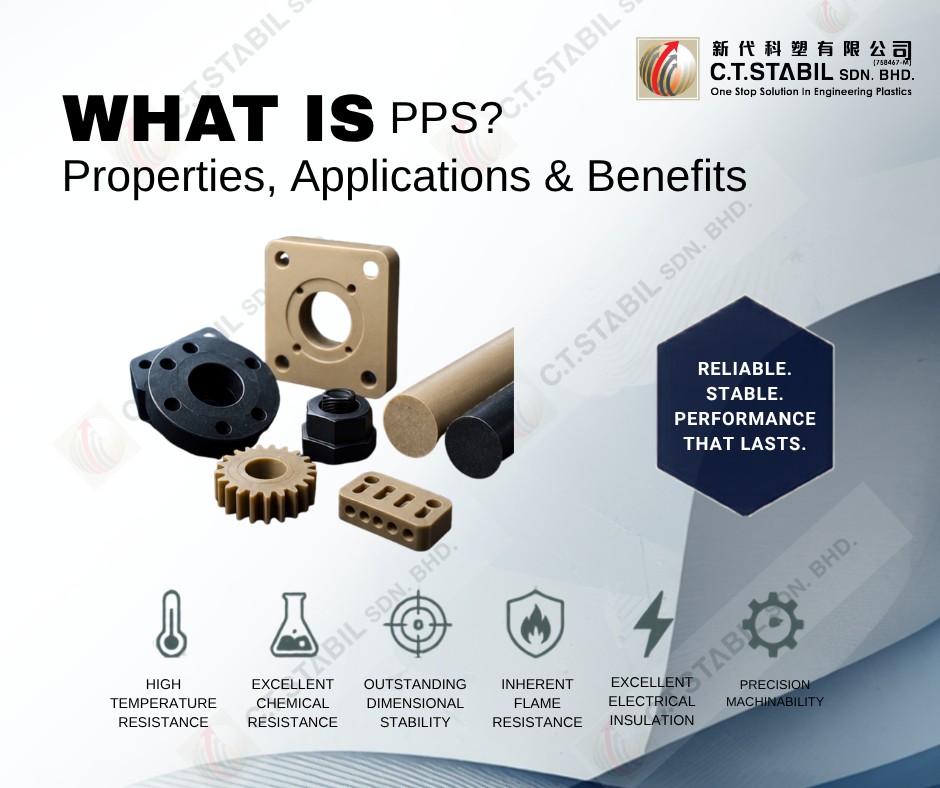
6 -7 minutes reading
⭐ Material Snapshot
Material Name: Polyphenylene Sulphide (PPS)
Material Family: Semi-crystalline High-Performance Engineering Thermoplastic
Continuous Operating Temperature: Approximately 220°C
Key Strengths
- Excellent chemical resistance
- Outstanding dimensional stability
- Very low moisture absorption
- Inherent flame resistance
- Excellent electrical insulation
- Excellent precision machinability
Common Applications
- Semiconductor equipment
- Pump and valve components
- Electrical and electronic insulation
- Chemical processing equipment
- Precision-machined industrial parts
- Food processing machinery
Introduction
When engineering applications demand a material capable of withstanding high temperatures, aggressive chemicals, and tight dimensional tolerances, Polyphenylene Sulphide (PPS) is often one of the first engineering plastics considered.
PPS is recognised as one of the world’s leading high-performance engineering thermoplastics, combining excellent thermal stability, outstanding chemical resistance, low moisture absorption, and reliable mechanical performance in a single material.
These characteristics make PPS a popular choice across industries such as semiconductor manufacturing, chemical processing, electrical and electronics, food processing, and industrial automation.
Although it is sometimes compared with higher-performance materials such as PEEK, PPS offers an exceptional balance of performance, reliability, and manufacturability for many demanding industrial applications. Understanding its properties and capabilities helps engineers determine when PPS is the most appropriate material for a specific application.
What Is PPS?
Polyphenylene Sulphide (PPS) is a semi-crystalline, high-performance engineering thermoplastic known for its excellent resistance to heat, chemicals, and environmental exposure.
Unlike many conventional engineering plastics, PPS maintains its dimensional stability and mechanical properties even when exposed to elevated temperatures and challenging industrial environments.
Another distinguishing feature of PPS is its exceptionally low moisture absorption. Because it absorbs very little water, PPS experiences minimal dimensional change due to humidity, making it well suited for precision-machined components where tight tolerances must be maintained.
PPS is available in several grades, including unfilled, glass-filled, mineral-filled, carbon-filled, and bearing grades, allowing engineers to select materials tailored to different mechanical and thermal requirements.
What Are the Key Properties of PPS?
PPS has earned its reputation as one of the leading high-performance engineering plastics because it combines several desirable properties in a single material. Rather than excelling in only one area, PPS offers a balanced combination of thermal, mechanical, chemical, and electrical performance that makes it suitable for demanding industrial environments.
Some of its most notable properties include:
Excellent Heat Resistance
PPS can typically operate continuously at temperatures of approximately 220°C, allowing it to maintain reliable performance in applications exposed to prolonged heat.
Its thermal stability makes it suitable for components used in electrical equipment, semiconductor manufacturing, industrial processing machinery, and chemical handling systems.
Outstanding Chemical Resistance
One of PPS’s greatest strengths is its resistance to a wide range of industrial chemicals.
It performs well when exposed to many acids, alkalis, fuels, solvents, and hydraulic fluids, making it a preferred material for pump components, valve parts, and chemical processing equipment.
However, as with all engineering plastics, chemical compatibility should always be verified against the specific operating conditions and chemical concentrations.
Exceptional Dimensional Stability
PPS absorbs very little moisture from its surrounding environment.
Because of this, components manufactured from PPS maintain their dimensions even under changing humidity conditions.
This characteristic is particularly valuable for precision-machined parts where tight tolerances are critical.
Excellent Electrical Insulation
PPS offers excellent electrical insulating properties over a broad temperature range.
Combined with its inherent flame resistance, this makes it suitable for electrical connectors, switchgear components, insulating fixtures, and electronic assemblies.
Good Mechanical Strength
Although materials such as PEEK may offer higher mechanical strength, PPS provides more than sufficient strength and rigidity for many industrial applications.
Its combination of stiffness, stability, and heat resistance enables it to perform reliably in components subjected to continuous service.
Excellent Machinability
PPS is widely used for precision-machined components because it can be manufactured to tight tolerances while maintaining excellent dimensional consistency.
This makes it suitable for producing complex engineering parts used in automation equipment, semiconductor fixtures, pump systems, and other high-precision applications.
Where Is PPS Commonly Used?
Because of its balanced performance characteristics, PPS has become a trusted engineering material across numerous industries.
Semiconductor Industry
PPS is widely used in semiconductor manufacturing equipment due to its dimensional stability, low moisture absorption, and ability to perform reliably under elevated temperatures.
Typical applications include:
- Wafer handling components
- Test fixtures
- Process equipment
- Precision insulating parts
Chemical Processing
PPS performs well in chemically aggressive environments where resistance to corrosion and dimensional stability are important.
Common applications include:
- Pump housings
- Valve components
- Sealing systems
- Chemical handling equipment
Electrical and Electronics
Its excellent electrical insulation and inherent flame resistance make PPS suitable for:
- Electrical connectors
- Insulating components
- Switchgear parts
- Electronic housings
Industrial Automation
Many automation systems require precision-machined components capable of maintaining dimensional accuracy over long operating periods.
PPS is frequently selected for:
- Bearings
- Bushings
- Wear components
- Precision guides
- Mechanical fixtures
Food Processing Equipment
Selected PPS grades are used in food processing equipment where dimensional stability, chemical resistance, and reliable performance during cleaning operations are required.
Material selection should always consider the applicable food-contact regulations for the intended market and the specific grade being used.
Why Do Engineers Choose PPS?
Engineering material selection is rarely based on a single property.
Instead, engineers evaluate how well a material performs across all aspects of the application.
PPS is often chosen because it offers an excellent balance of:
- Heat resistance
- Chemical resistance
- Dimensional stability
- Electrical insulation
- Precision machinability
- Long-term reliability
Rather than delivering the highest performance in every category, PPS provides dependable and consistent performance across a broad range of industrial environments.
For many applications, this balanced performance makes PPS an efficient and practical engineering solution.
Is PPS the Right Material for Every Application?
Although PPS is one of the world’s leading high-performance engineering plastics, it is not automatically the best choice for every engineering application.
Applications involving continuous temperatures approaching 250°C, exceptionally high mechanical loads, or specialised medical or aerospace requirements may benefit from materials such as PEEK.
Similarly, applications where low friction is the primary requirement may be better served by PTFE, while wear-intensive conveyor systems may benefit from UHMW-PE.
The most successful engineering designs begin by understanding the application’s operating conditions before selecting the material.
Rather than asking “Which engineering plastic is the best?”, engineers should ask:
“Which engineering plastic is best suited to this application?”
This approach helps ensure reliable performance, efficient manufacturing, and long-term value.
Conclusion
Polyphenylene Sulphide (PPS) has established itself as one of the world’s most trusted high-performance engineering plastics by offering an exceptional combination of heat resistance, chemical resistance, dimensional stability, and precision machinability.
These characteristics make PPS a reliable material for demanding applications across industries such as semiconductor manufacturing, chemical processing, electrical and electronics, industrial automation, and food processing.
Unlike many engineering materials that excel in only one area, PPS provides a well-balanced performance profile that enables engineers to solve a wide range of design challenges while maintaining long-term reliability.
However, no engineering plastic is universally suitable for every application.
Successful material selection requires careful consideration of operating temperature, mechanical loading, chemical exposure, dimensional tolerance, manufacturing requirements, and overall project objectives.
At C.T. Stabil, we believe the best engineering plastic is not necessarily the one with the highest specifications—it is the one that delivers the right balance of performance, reliability, manufacturability, and engineering value for the intended application.
Whether you are designing new equipment or replacing an existing component, understanding the capabilities of PPS is the first step towards making informed engineering decisions.
Continue Learning
Interested in expanding your knowledge of engineering plastics? Continue with these related technical publications:
- What Is PEEK? Properties, Applications and Benefits
- Why Is UHMW-PE So Wear Resistant?
- What is Ertalyte™PET-P — and how does it differ from other PET brands?
- Which Engineering Plastic Has the Highest Operating Temperature?
- Techtron® PPS vs Standard PPS: What’s the Difference?
- PEEK vs PPS: Which High-Performance Engineering Plastic Should You Choose?
About CT Stabil Technical Publications
C.T. Stabil Technical Publications is a knowledge series created to help engineers, designers, purchasers, and manufacturers better understand engineering plastics and make informed material selection decisions.
Our publications combine engineering principles, recognised industry practices, manufacturer technical information, and practical application experience to deliver objective, educational, and application-focused content.
Our mission is to simplify complex material selection decisions while promoting sound engineering practices across a wide range of industrial applications.
Article Information
| Information | Details |
| Series | What Is? |
| Publication No. | CTS-WI-005 |
| Article Title | What Is PPS? Properties, Applications and Benefits |
| Technical Level | Beginner |
| Estimated Reading Time | 6 -7 min read |
| Published | July 2026 |
| Last Reviewed | July 2026 |
| Prepared by | C.T. Stabil Technical Publications |
| Technical Review | C.T. Stabil Engineering Team |
Technical Disclaimer
This publication is intended for educational and general engineering reference purposes only.
The information presented reflects commonly accepted engineering principles together with industry references available at the time of publication. Material properties, performance characteristics, and application suitability may vary depending on the manufacturer, material grade, processing methods, operating conditions, component design, and service environment.
Readers should verify all technical information and consult the relevant manufacturer’s technical documentation before making engineering, design, or purchasing decisions.
Nothing contained in this publication should be interpreted as a substitute for professional engineering judgement or application-specific testing.
Copyright Notice
© 2026 CT Stabil Sdn. Bhd. All rights reserved.
This publication forms part of the C.T. Stabil Technical Publications series.
You may quote brief excerpts from this publication for educational or editorial purposes provided appropriate attribution is given to CT Stabil Sdn. Bhd.
Reproduction, republication, or redistribution of this publication in whole or in substantial part without prior written permission is prohibited.
References & Further Reading
The information presented in this publication has been prepared with reference to recognised engineering resources, including:
- Manufacturer technical data for commercially available PPS materials
- Material property information published by leading engineering plastics manufacturers
- ASTM International standards relating to plastics testing and material characterisation
- ISO standards relevant to engineering plastics
- Engineering plastics reference handbooks
- Practical engineering knowledge and application experience from the C.T. Stabil Engineering Team