


ENGINEERING INSIGHTS: PEEK vs PPS – Which High-Performance Engineering Plastic Should You Choose?
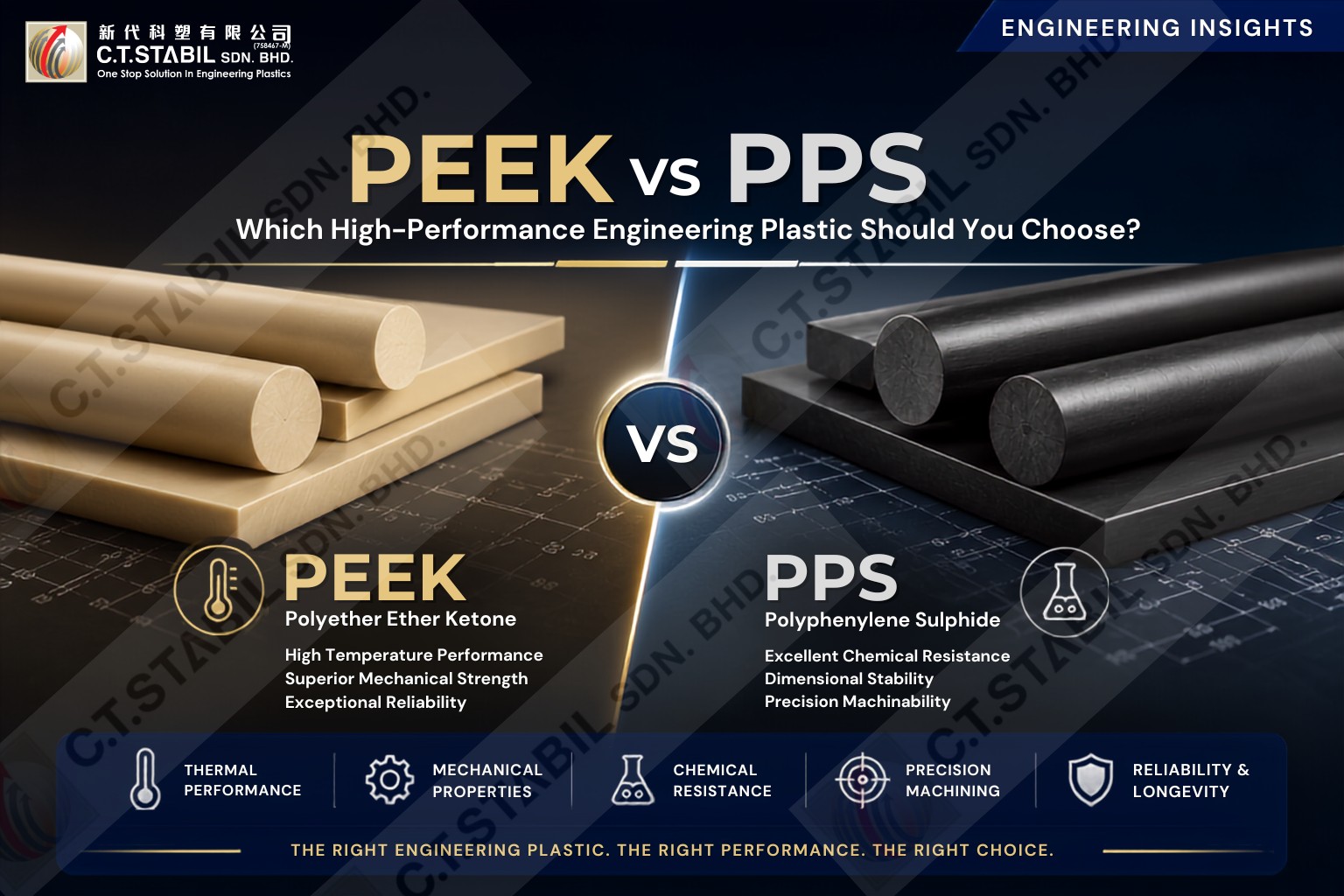
⚡ Engineering Snapshot
- PEEK generally offers higher continuous operating temperatures and greater mechanical strength.
- PPS excels in dimensional stability and chemical resistance for many industrial applications.
- Neither material is universally better—the correct choice depends on the operating environment.
- Engineers should evaluate total engineering value rather than relying solely on material cost.
18 – 20 minutes reading
Executive Summary
PEEK (Polyether Ether Ketone) and PPS (Polyphenylene Sulphide) are among the most widely used high-performance engineering plastics in demanding industrial applications. Both materials offer outstanding thermal stability, excellent chemical resistance, low moisture absorption, and exceptional dimensional stability, making them popular choices in industries such as semiconductor manufacturing, chemical processing, food production, aerospace, medical technology, and precision engineering.
Because both materials share many similar characteristics, engineers are often faced with an important question:
Which material is the better choice for my application?
The answer is not simply “PEEK” or “PPS.”
Instead, the decision depends on balancing operating temperature, mechanical loading, chemical exposure, machining requirements, dimensional stability, regulatory requirements, availability, and overall project objectives.
In this Engineering Insights article, we compare PEEK and PPS from an engineering perspective—not to determine which material is “better,” but to help engineers understand where each material performs best.
By the end of this guide, you will understand:
- The key differences between PEEK and PPS.
- How their mechanical and thermal properties compare.
- Which material performs better under different operating conditions.
- When PPS may be the more practical engineering solution.
- When PEEK’s additional capabilities justify its selection.
Rather than relying solely on datasheet values, this guide focuses on the practical considerations engineers evaluate when specifying materials for real-world industrial applications.
Introduction
Selecting a high-performance engineering plastic is rarely as straightforward as comparing a few mechanical properties on a datasheet.
In practice, engineers must consider how a material behaves throughout its entire service life. A component may operate under elevated temperatures, encounter aggressive chemicals, require tight machining tolerances, or run continuously for thousands of hours without failure.
Among the many engineering plastics available today, PEEK and PPS are frequently compared because both occupy the premium end of the engineering plastics spectrum. At first glance, they appear remarkably similar. Both offer excellent heat resistance, broad chemical compatibility, low moisture absorption, and outstanding dimensional stability.
However, once the application becomes more demanding, important differences begin to emerge. For example:
- Does the application require continuous operation above 220°C?
- Will the component experience high mechanical loads?
- Is dimensional stability more important than ultimate strength?
- Will the material be exposed to aggressive chemicals?
- Does the application justify selecting a higher-performance material, or will a more economical solution provide the same result?
These are the questions experienced engineers ask before specifying a material.
This article explores those questions in detail, providing practical guidance based on engineering principles rather than marketing claims.
The objective is simple:
Help you select the material that best fits your application—not merely the material with the highest specifications.
Why Are PEEK and PPS Often Compared?
Among high-performance engineering plastics, PEEK (Polyether Ether Ketone) and PPS (Polyphenylene Sulphide) are frequently considered together because they share several important characteristics.
Both materials are capable of operating in demanding industrial environments where conventional engineering plastics may struggle. They offer excellent heat resistance, outstanding chemical resistance, low moisture absorption, and high dimensional stability, making them suitable for precision components used in industries such as semiconductor manufacturing, chemical processing, medical equipment, food processing, electronics, and industrial automation.
At first glance, their datasheets may appear surprisingly similar.
Both materials can:
- Operate at elevated temperatures.
- Resist a wide range of industrial chemicals.
- Maintain dimensional stability under varying environmental conditions.
- Be precision machined into complex components.
- Replace metals in selected applications to reduce weight and eliminate corrosion.
Because of these similarities, engineers often compare PEEK and PPS during the early stages of material selection.
However, selecting between the two is rarely as simple as comparing a list of mechanical properties.
Similar Materials, Different Design Priorities
Although PEEK and PPS belong to the same category of high-performance engineering plastics, they were developed with different engineering priorities in mind.
PEEK is widely recognised for its exceptional mechanical strength, excellent fatigue resistance, and ability to maintain these properties under continuous high-temperature operation. These characteristics make it a preferred choice for applications involving demanding mechanical loads or extreme operating conditions.
PPS, meanwhile, is highly regarded for its outstanding dimensional stability, excellent chemical resistance, inherent flame resistance, and reliable machining performance. For many industrial applications operating within its temperature range, PPS provides an excellent balance between performance and practicality.
Rather than competing directly, the two materials often complement each other.
In many projects, either material may satisfy the technical requirements. The engineering challenge lies in identifying which one provides the most appropriate balance of performance, manufacturability, availability, and overall project value.
Engineering Decision Point
Start by defining the application—not the material.
Before comparing datasheets, identify the critical requirements of your application:
- What is the maximum continuous operating temperature?
- Will the component experience significant mechanical loads?
- Is chemical resistance a primary concern?
- Are tight machining tolerances required?
- Will the component operate continuously or intermittently?
- Are regulatory approvals such as food contact or medical compliance required?
Answering these questions first often narrows the material choice more effectively than comparing specifications alone.
Understanding the Two Materials
Before comparing their engineering performance, it is useful to understand what each material was designed to achieve.
What Is PEEK?
PEEK (Polyether Ether Ketone) is a semi-crystalline high-performance thermoplastic belonging to the polyaryletherketone (PAEK) family.
It is recognised globally for its exceptional combination of mechanical strength, thermal stability, wear resistance, and chemical resistance. Because it maintains these properties at elevated temperatures, PEEK is widely specified for demanding applications in aerospace, semiconductor manufacturing, medical devices, oil and gas, and precision engineering.
For readers seeking a broader introduction to this material, see our article “What Is PEEK? Properties, Applications and Benefits.”
What Is PPS?
PPS (Polyphenylene Sulphide) is another semi-crystalline high-performance engineering plastic known for its excellent dimensional stability, low moisture absorption, chemical resistance, and inherent flame resistance.
Its combination of thermal performance and excellent machinability makes it a popular choice for precision-machined components, pump and valve parts, semiconductor equipment, electrical insulation, and chemical processing systems.
PPS is available in a variety of grades, including unfilled, glass-filled, carbon-filled, and bearing grades, allowing engineers to tailor material performance to specific application requirements.
If you’re new to this material, our article “What Is PPS? Properties, Applications and Benefits” provides a complete introduction, while “Techtron® PPS vs Standard PPS: What’s the Difference?” explores how manufacturing quality and material consistency can influence engineering performance.
A Quick Comparison Before We Dive Deeper
Although PEEK and PPS are often considered alternatives, their strengths become more apparent when viewed side by side.
| Engineering Consideration | PEEK | PPS |
| Continuous operating temperature | Higher | Excellent for most industrial applications |
| Mechanical strength | Higher | Very good |
| Chemical resistance | Excellent | Excellent |
| Dimensional stability | Excellent | Excellent |
| Moisture absorption | Extremely low | Extremely low |
| Precision machining | Excellent | Excellent |
| Availability of grades | Extensive | Extensive |
| Typical engineering focus | Maximum performance | Balanced performance and value |
This comparison provides only a high-level overview.
The following sections examine each engineering consideration in greater detail, helping you determine which material is best suited to your specific application.
How Much Heat Can PEEK and PPS Really Handle?
One of the first factors engineers evaluate when selecting a high-performance engineering plastic is its ability to withstand elevated temperatures.
Although both PEEK and PPS are recognised for their excellent thermal performance, they are designed to operate within different temperature ranges.
Generally, PEEK offers a higher continuous operating temperature, typically around 250°C, while PPS is commonly rated for continuous operation up to approximately 220°C, depending on the material grade and application.
On paper, a difference of around 30°C may appear relatively small. However, in engineering practice, that additional thermal margin can significantly influence long-term component reliability.
For example, components operating continuously at temperatures approaching 230–240°C may exceed the recommended operating range of PPS, whereas PEEK continues to maintain excellent mechanical properties under these demanding conditions.
This is one of the reasons why PEEK is frequently specified for:
- Aerospace components
- Oil & gas equipment
- High-temperature bearings
- Medical sterilisation equipment
- Semiconductor processing systems with elevated thermal requirements
However, this does not mean PPS is unsuitable for high-temperature applications.
Many industrial systems operate comfortably below 200°C, where PPS provides outstanding performance while offering excellent dimensional stability and chemical resistance.
The engineering question should therefore be:
Does your application genuinely require PEEK’s additional temperature capability?
If the answer is no, PPS may already satisfy all functional requirements.
Engineering Decision Point
If your application operates continuously below 200°C, temperature alone is rarely sufficient justification for selecting PEEK.
Instead, evaluate the complete operating environment, including mechanical loading, chemical exposure, machining requirements, and expected service life.
Which Material Performs Better Under Mechanical Loads?
Temperature is only one aspect of material selection.
Mechanical performance often becomes the deciding factor when components are subjected to continuous loads, repeated stress, or demanding operating conditions.
This is an area where PEEK generally demonstrates a clear advantage.
PEEK retains excellent tensile strength, stiffness, creep resistance, and fatigue performance even at elevated temperatures. These characteristics allow it to perform reliably in heavily loaded components where long-term dimensional accuracy and mechanical integrity are critical.
Examples include:
- Structural supports
- High-load bearings
- Compressor components
- Pump wear parts
- Precision gears
- Aerospace mechanisms
PPS also provides excellent mechanical properties and is more than capable of handling many industrial applications.
However, compared with PEEK, PPS is generally selected for applications where dimensional stability, chemical resistance, and thermal performance are more critical than maximum mechanical strength.
For many precision-machined components, the difference is not whether PPS is “strong enough,” but whether the application truly benefits from PEEK’s higher mechanical capability.
How Do They Compare in Chemically Aggressive Environments?
Both PEEK and PPS are widely recognised for their excellent chemical resistance.
This often surprises engineers because the comparison is not as straightforward as many expect.
PEEK performs exceptionally well against a broad range of industrial chemicals, including hydrocarbons, oils, fuels, steam, and many organic solvents. It is widely used in demanding industries such as oil & gas, aerospace, and medical technology because of its ability to combine chemical resistance with outstanding mechanical performance.
PPS, however, also exhibits excellent resistance to many acids, alkalis, and industrial solvents. In chemical processing equipment, valve components, pumps, and fluid handling systems, PPS has built a strong reputation for maintaining performance in aggressive operating environments.
Rather than asking which material has “better” chemical resistance, engineers should ask a more practical question:
Which chemicals will the component actually encounter?
Chemical compatibility depends on factors such as:
- Chemical type
- Concentration
- Operating temperature
- Exposure duration
- Mechanical loading
- Pressure
These variables can influence material performance far more than the material name alone. For this reason, engineers should always consult chemical compatibility data for the specific operating conditions before making a final material selection.
Engineering Decision Point
Neither PEEK nor PPS is universally superior in every chemical environment.
The most reliable approach is to evaluate the actual chemicals, operating temperature, concentration, and exposure time rather than relying on general material rankings.
Which Material Is Better for Precision Machining?
Both PEEK and PPS are widely used for precision-machined engineering components, but they are often selected for different reasons.
PEEK is valued for its combination of high strength, excellent dimensional stability, and ability to maintain tight tolerances in demanding operating environments.
PPS is equally respected for its low moisture absorption, predictable machining behaviour, and excellent dimensional consistency.
For machine shops producing precision components, both materials offer excellent machinability when appropriate cutting tools, feeds, speeds, and work-holding techniques are used.
The final choice therefore depends less on whether one material machines “better” than the other and more on the performance required after machining.
If the component must withstand higher temperatures and mechanical loads, PEEK may offer additional engineering confidence.
If dimensional stability, chemical resistance, and reliable machining are the primary priorities within PPS’s operating range, PPS may provide an equally effective solution.
Engineering Insight
Successful material selection is rarely about finding the material with the highest specification.
It is about identifying the material that provides the right balance of thermal performance, mechanical properties, machinability, chemical resistance, and long-term reliability for the intended application.
That balance—not any single property—is what distinguishes good engineering decisions from expensive ones.
Is PEEK Really More Expensive Than PPS?
One of the most common assumptions in engineering plastics is that PEEK is always more expensive than PPS.
While this may be true in many markets, the reality is often more complex.
Material pricing is influenced by numerous factors, including manufacturer, material grade, supply chain conditions, regional demand, inventory availability, exchange rates, purchasing volume, and local distribution networks. As a result, the price relationship between PEEK and PPS can vary from one market to another and may even change over time.
For engineers and purchasing teams, this highlights an important principle:
Material selection should never be based solely on historical assumptions or published price rankings.
Instead, engineers should evaluate the complete engineering and commercial picture.
Looking Beyond Material Price
The purchase price of a plastic sheet or rod is only one part of the total project cost.
In many applications, the following factors have a much greater impact on the overall cost of ownership:
- Service life of the component
- Equipment downtime during replacement
- Machining efficiency
- Material availability and lead time
- Scrap rate during production
- Maintenance frequency
- Production reliability
- Energy and operating efficiency
For example, a material with a higher purchase price may actually reduce long-term operating costs if it extends component life or minimises unplanned downtime.
Conversely, specifying a material with performance well beyond the application’s actual requirements may increase project costs without delivering measurable benefits.
The objective is therefore not to identify the cheapest material, but the material that delivers the greatest overall value throughout its service life.
Engineering Decision Point
Always evaluate total engineering value, not simply material cost.
The most economical material is not necessarily the one with the lowest purchase price—it is the one that provides the required performance with the lowest overall lifecycle cost.
How Do Availability and Lead Time Influence Material Selection?
Material availability is another factor that is sometimes overlooked during the design stage.
Even when two materials offer similar technical performance, differences in inventory availability or procurement lead times can affect project schedules, production planning, and maintenance activities.
For manufacturers operating under tight delivery deadlines, selecting a material that is readily available may help reduce procurement risks and shorten production lead times.
Similarly, standardising on commonly stocked materials can simplify inventory management and improve long-term maintenance support.
These commercial considerations should not replace sound engineering judgement, but they are often important factors in successful project execution.
Which Industries Commonly Choose PEEK or PPS?
Although PEEK and PPS share many characteristics, each material has established strengths within different industries.
PEEK is commonly specified for:
- Aerospace components
- Medical devices and sterilisation equipment
- Oil & gas equipment
- High-performance bearings
- Semiconductor equipment operating at elevated temperatures
- Precision components subjected to high mechanical loads
PEEK is typically selected when maximum mechanical performance and high-temperature capability are critical to long-term reliability.
PPS is commonly specified for:
- Chemical processing equipment
- Pump and valve components
- Semiconductor fixtures and handling equipment
- Electrical and electronic insulation
- Precision-machined industrial components
- Applications requiring excellent dimensional stability and chemical resistance
Within its operating temperature range, PPS often provides an excellent balance between performance, manufacturability, and long-term reliability.
Engineering Selection Matrix
Rather than asking which material is “better,” experienced engineers usually begin by asking which material best matches the application’s operating conditions.
The following matrix provides a practical starting point.
| Application Requirement | Recommended Material |
| Continuous operation approaching 250°C | PEEK |
| High mechanical loads at elevated temperatures | PEEK |
| Outstanding dimensional stability below approximately 220°C | PPS |
| Excellent chemical resistance in industrial environments | PEEK or PPS (application dependent) |
| Precision-machined components | PEEK or PPS |
| High-temperature electrical insulation | PPS |
| Aerospace and medical applications | PEEK |
| General industrial equipment requiring balanced performance | PPS |
This matrix should be viewed as a decision aid rather than a definitive specification guide. Every application should be evaluated individually, taking into account operating conditions, component geometry, regulatory requirements, and expected service life.
C.T. Stabil Engineering Recommendation
Comparing PEEK and PPS should never be about declaring one material superior to the other.
Both materials are exceptional high-performance engineering plastics, each developed to address different engineering challenges.
If an application demands continuous operation at very high temperatures, exceptional mechanical strength, and long-term performance under demanding loads, PEEK is often the preferred choice.
If the application prioritises dimensional stability, chemical resistance, precision machining, and reliable performance within its operating temperature range, PPS may provide an equally effective solution.
The most successful material selection is achieved by understanding the application’s technical requirements first and then selecting the material that provides the most appropriate balance of performance, reliability, manufacturability, availability, and overall engineering value.
At C.T. Stabil, we work closely with customers to evaluate these factors and recommend engineering plastics based on practical application requirements rather than relying solely on material specifications or conventional assumptions.
Conclusion
PEEK and PPS are both outstanding high-performance engineering plastics, but they are designed to solve different engineering challenges.
PEEK is recognised for its exceptional mechanical strength, superior high-temperature performance, and ability to maintain its properties under demanding operating conditions. These characteristics make it an excellent choice for applications involving elevated temperatures, continuous mechanical loading, and industries where performance is paramount, such as aerospace, medical technology, oil & gas, and advanced semiconductor manufacturing.
PPS, on the other hand, offers an outstanding combination of dimensional stability, chemical resistance, inherent flame resistance, and precision machinability. For many industrial applications operating within its recommended temperature range, PPS delivers excellent long-term performance while remaining a highly practical engineering solution.
The key lesson is that material selection should never be based solely on a single specification or industry perception.
Instead, engineers should evaluate the complete operating environment, including:
- Continuous operating temperature
- Mechanical loading
- Chemical exposure
- Dimensional stability requirements
- Manufacturing and machining considerations
- Material availability
- Expected service life
- Overall engineering value
Rather than asking “Which material is better?”, experienced engineers ask:
“Which material is better for this application?”
That simple shift in thinking often leads to better engineering decisions, improved equipment reliability, and more cost-effective projects.
At C.T. Stabil, we believe the best engineering plastic is not necessarily the one with the highest specifications—it is the one that best satisfies the technical and commercial requirements of the application.
About CT Stabil Technical Publications
CT Stabil Technical Publications is an educational knowledge series developed to help engineers, designers, purchasers, and manufacturers better understand engineering plastics and make informed material selection decisions.
Each publication combines engineering principles, industry practices, manufacturer information, and practical application experience to provide balanced, objective, and technically focused guidance.
Our goal is not simply to introduce engineering materials, but to help readers understand why a material is selected, how it performs in real-world applications, and when it represents the most appropriate engineering solution.
Article Information
| Information | Details |
| Series | Engineering Insights |
| Publication No. | CTS-EI-002 |
| Article Title | PEEK vs PPS: Which High-Performance Engineering Plastic Should You Choose? |
| Technical Level | Advanced |
| Estimated Reading Time | 18 – 20 min read |
| Published | July 2026 |
| Last Reviewed | July 2026 |
| Prepared by | CT Stabil Technical Publications |
| Technical Review | CT Stabil Engineering Team |
Technical Disclaimer
This publication is intended for educational and general engineering reference purposes only.
The information presented reflects commonly accepted engineering principles together with industry references available at the time of publication. Material properties, performance characteristics, and application suitability may vary depending on the manufacturer, material grade, processing method, operating environment, component design, and service conditions.
Readers should verify all technical information and consult the relevant manufacturer data before making engineering, design, or purchasing decisions.
Nothing contained in this publication should be interpreted as a substitute for professional engineering judgement or application-specific testing.
Copyright Notice
© 2026 C.T. Stabil Sdn. Bhd. All rights reserved.
This publication forms part of the C.T. Stabil Technical Publications series.
You may quote brief excerpts from this publication for educational or editorial purposes provided appropriate attribution is given to C.T. Stabil Sdn. Bhd.
Reproduction, republication, or redistribution of this publication in whole or in substantial part without prior written permission is prohibited.