


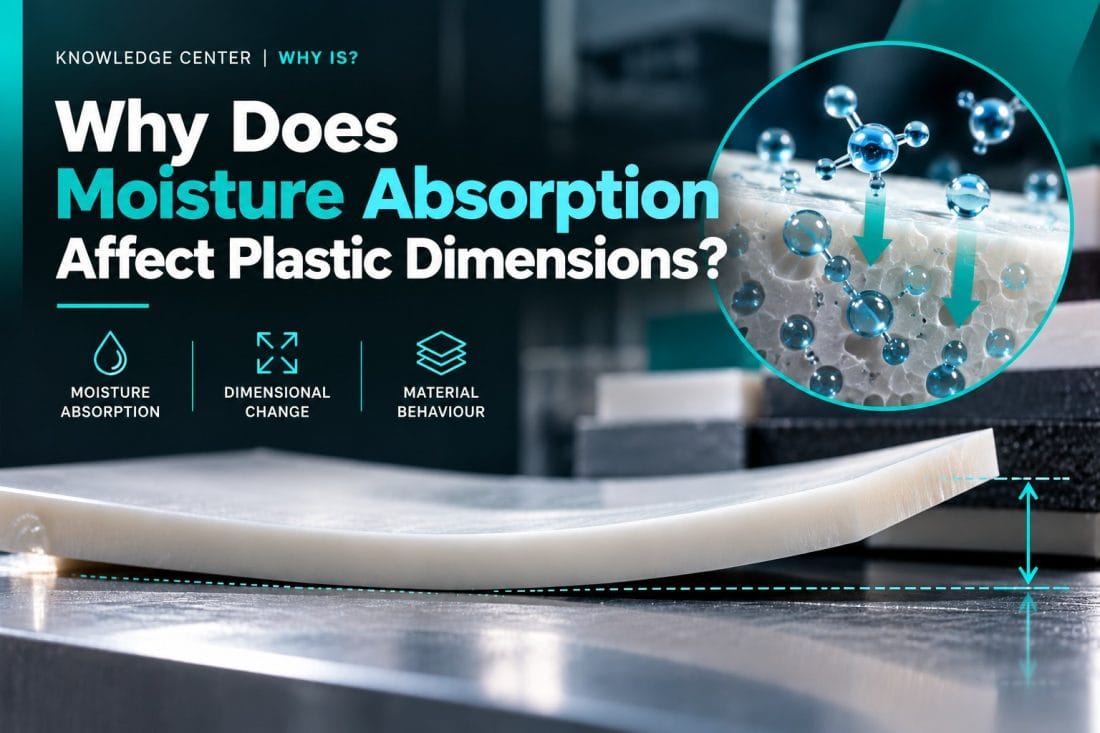
Why Does Moisture Absorption Affect Plastic Dimensions?
Knowledge Center | Why Is? Series
6 – 7 minutes reading
Introduction: Why Do Plastic Parts Change Dimensions?
Engineering plastics are widely used in precision-machined components because of their strength, wear resistance, chemical resistance and machinability. However, even a correctly machined plastic component may experience dimensional changes after being exposed to a different environment.
One important factor is moisture absorption.
Unlike metals, some engineering plastics can absorb water from the surrounding air or through direct contact with water. This absorbed moisture can cause the material to swell, alter its mechanical properties and affect the dimensional accuracy of finished components.
These changes can become important when manufacturing gears, bearings, bushings, guide rails, precision fixtures and other components with tight tolerances.
However, not all engineering plastics respond to moisture in the same way. Nylon, for example, absorbs considerably more moisture than POM (acetal), while materials such as PEEK, PPS and PEI generally exhibit low moisture absorption.
Understanding these differences helps engineers and manufacturers select suitable materials, establish realistic machining tolerances and reduce dimensional problems during service.
1. What Happens When Engineering Plastics Absorb Moisture?
Moisture absorption occurs when water molecules enter a polymer from its surrounding environment. Depending on the material, this can happen through exposure to humid air, water immersion or repeated changes in environmental conditions.
As moisture enters the polymer structure, it can alter the spacing and interactions between polymer chains. In moisture-sensitive materials, this can lead to dimensional expansion and changes in stiffness, strength and toughness.
For precision engineering, even a relatively small dimensional change can be significant.
For example, a component designed to fit within a narrow clearance may become too large after absorbing moisture. This can increase friction, affect assembly, change running clearances or cause a mechanism to operate outside its intended tolerances.
The extent of the change depends on several factors:
- Polymer type: Different materials have different affinities for water.
- Humidity and exposure: Higher humidity and longer exposure can increase moisture uptake.
- Component thickness: Moisture takes time to diffuse through a material, so thick sections may condition more slowly than thin sections.
- Temperature: Temperature affects moisture diffusion and the material’s dimensional response.
- Material structure and processing: Reinforcement, orientation, crystallinity and residual manufacturing stresses can influence dimensional behaviour.
Therefore, dimensional stability should be assessed under the conditions in which the component will actually be used, rather than relying exclusively on dry-state material properties.
2. Which Engineering Plastics Are Most Affected by Moisture?
Moisture sensitivity varies significantly between engineering plastics. Material selection should consider the required tolerance, operating environment and expected service life.
Nylon (PA)
Nylon, including PA6 and PA66, is one of the most important materials to consider when moisture absorption is a concern.
Nylon can absorb moisture from humid air, causing measurable swelling and changes in mechanical properties. Its stiffness and strength may decrease as moisture content increases, while toughness can improve.
These characteristics do not make nylon unsuitable for precision applications. However, designers must account for the material’s expected moisture condition when specifying dimensions and clearances.
For components operating in environments with changing humidity, dimensional changes should be evaluated before finalising the material and machining tolerances.
POM (Acetal)
POM, also known as acetal, is widely used for precision-machined parts because of its low moisture absorption, good dimensional stability, strength and machinability.
Compared with conventional nylon grades, POM generally experiences much smaller dimensional changes caused by moisture uptake.
This makes it suitable for applications such as gears, rollers, bushings, guide components and precision mechanical parts.
Nevertheless, low moisture absorption does not mean that POM is immune to dimensional instability. Manufacturing stresses, uneven cooling, temperature changes and machining conditions can still contribute to distortion.
PET (Polyethylene Terephthalate)
Engineering-grade PET, including PET-P materials such as Ertalyte™, offers good dimensional stability and low moisture absorption.
It is often considered for precision components where stiffness, wear performance and dimensional accuracy are important.
As with other polymers, the performance of a particular PET grade should be assessed against the manufacturer’s technical data and the actual service environment.
PEEK, PPS and PEI
High-performance engineering plastics such as PEEK, PPS and PEI generally exhibit low moisture absorption and can provide good dimensional stability in demanding applications.
These materials may be considered when components must maintain their dimensions under specific combinations of temperature, mechanical loading and environmental exposure.
However, they are not interchangeable. Their thermal properties, chemical resistance, mechanical performance and costs differ, so the appropriate grade must be selected according to the application requirements.
Quick Comparison
| Material | General moisture behaviour | Dimensional consideration |
|---|---|---|
| Nylon (PA6/PA66) | Relatively high moisture absorption | Moisture-related swelling can be significant |
| POM (acetal) | Low moisture absorption | Good dimensional stability, but residual stress and temperature still matter |
| PET-P | Low moisture absorption | Suitable for many precision applications |
| PEEK | Low moisture absorption | Useful for demanding applications; assess grade and operating conditions |
| PPS | Low moisture absorption | Good candidate where environmental dimensional stability matters |
| PEI | Low moisture absorption | Consider the full temperature and mechanical requirements |
This is a general comparison, not a guaranteed ranking for every commercial grade. Actual performance depends on formulation, processing, geometry and test conditions.
3. Why Can Moisture Absorption Cause Machining Problems?
Dimensional changes become particularly important when engineering plastics are machined to tight tolerances.
A component may meet its specified dimensions immediately after machining but change size after conditioning in a different environment.
For example, a nylon bushing machined in a relatively dry workshop may absorb moisture after installation in a humid operating environment. The resulting expansion can reduce the clearance between the bushing and its mating shaft.
Potential consequences include:
- Increased friction or interference during assembly.
- Changes in gear backlash or running clearance.
- Reduced dimensional accuracy in precision components.
- Changes in flatness or fit where dimensional changes are uneven.
- Increased rejection rates when finished parts are inspected under different environmental conditions.
These issues are especially important for components that must maintain close tolerances over long periods.
For this reason, the dimensional condition of a material during inspection should be relevant to its intended service environment. Where moisture-related dimensional change is significant, conditioning requirements and tolerances should be agreed upon before production.
4. Is Moisture the Only Cause of Plastic Warping?
No. This distinction is important because not every warped engineering plastic sheet or machined component has been affected by moisture absorption.
Several mechanisms can contribute to dimensional instability.
Residual Manufacturing Stress
During extrusion, moulding or other manufacturing processes, a polymer may develop internal stresses because of uneven cooling, molecular orientation or processing conditions.
These stresses can remain in the material after production. When material is machined, heated or exposed to different conditions, the stresses may redistribute or relax, causing the component to distort.
Temperature Changes
Engineering plastics generally expand when heated and contract when cooled. Their thermal expansion is typically greater than that of many metals.
If a material experiences uneven temperature changes, different regions may expand or contract at different rates. Combined with residual stress or uneven support, this can contribute to bowing or warping.
Storage and Handling
Improper support, uneven stacking loads or prolonged storage under unsuitable conditions can also affect flatness.
Large sheets and thick blocks should be stored and handled according to supplier recommendations to minimise avoidable deformation.
A Real-World Example: Imported POM Sheets Arriving Bowed
In engineering plastics distribution, sheets manufactured overseas may experience different temperature conditions before reaching Malaysia.
For example, POM sheets produced during the manufacturer’s winter season may be transported and stored under changing environmental conditions before arriving in a warmer climate.
If the sheets arrive bowed, it is tempting to assume that the change in climate caused the problem through thermal expansion or moisture absorption alone.
However, POM is a low-moisture-absorption material. Its bowing should not automatically be attributed to humidity.
Possible contributing factors include residual stresses from manufacturing, temperature changes during transport, uneven cooling, and the way the sheets were supported or stacked.
The seasonal timing provides a useful clue, but it does not establish the root cause. A proper investigation should consider the material’s production history, transport conditions, storage method and flatness before and after acclimatisation.
This distinction matters because the corrective action depends on the cause. Moisture conditioning may be relevant for moisture-sensitive polymers, while a bowed POM sheet may require a different investigation into manufacturing stress, temperature history or handling.
5. How Can Dimensional Changes Be Minimized?
Although environmental effects cannot always be eliminated, several practical measures can help improve dimensional consistency.
1. Select the Right Material
Choose a material based on the actual operating environment, required tolerances, mechanical loads and chemical exposure.
Where moisture-related dimensional changes are unacceptable, consider low-moisture-absorption materials such as POM, PET-P, PEEK, PPS or PEI, provided their other properties meet the application requirements.
For nylon, account for the expected moisture condition when designing clearances and specifying finished dimensions.
2. Allow Materials to Acclimatise
Before precision inspection or machining, allow incoming material to reach a stable temperature in the intended working environment.
This helps reduce measurement differences caused by temperature changes. However, temperature acclimatisation does not necessarily eliminate residual manufacturing stresses or bring a moisture-sensitive polymer to equilibrium moisture content.
The required conditioning period depends on the material, thickness, temperature difference and supplier guidance.
3. Inspect Incoming Sheets and Blocks
Check incoming material for bowing, twisting, flatness and thickness variation before machining.
Record any visible distortion and compare measurements after the material has acclimatised. This can help distinguish a delivery condition from changes that develop during subsequent processing.
For critical applications, follow an agreed inspection method and suitable measurement conditions.
4. Use Appropriate Machining Strategies
For components with tight tolerances, consider staged machining where appropriate. Rough machining followed by stabilisation and finish machining can help manage dimensional changes associated with stress redistribution.
The exact procedure depends on the polymer, material grade, component geometry and supplier recommendations. Not every material requires the same treatment.
5. Maintain Suitable Storage Conditions
Store plastic sheets and blocks on flat, adequately supported surfaces. Avoid uneven loads and unsupported overhangs.
Where humidity affects the material, control the storage environment according to the supplier’s recommendations. Keep in mind that controlling humidity alone will not resolve every cause of warping.
6. Verify the Finished Component Under Relevant Conditions
For critical components, establish whether dimensional inspection should be performed in a dry, conditioned or representative operating environment.
Where necessary, evaluate dimensional changes after exposure to the expected temperature and humidity conditions. This is particularly important for assemblies with tight clearances or parts that operate in environments substantially different from the machining workshop.
6. How Should You Choose Between Nylon and POM for Dimensional Stability?
Nylon and POM are both widely used engineering plastics, but their behaviour differs.
Nylon offers good mechanical performance and wear resistance in many applications, but moisture absorption can cause dimensional changes that must be considered during design and machining.
POM generally absorbs much less moisture and is often preferred for precision components requiring stable dimensions and good machinability.
However, material selection should not be based on moisture absorption alone. Load capacity, wear behaviour, chemical compatibility, operating temperature, cost and manufacturing requirements must also be considered.
For applications involving tight tolerances, compare the technical data of the specific grades and evaluate performance under representative operating conditions.
Conclusion: Dimensional Stability Starts With Understanding the Environment
Moisture absorption can affect the dimensions and mechanical properties of engineering plastics, particularly moisture-sensitive materials such as nylon.
However, dimensional instability can also arise from residual manufacturing stresses, temperature changes, machining conditions and improper storage or handling.
Understanding the differences between these mechanisms helps engineers choose suitable materials, establish realistic tolerances and reduce avoidable production problems.
For engineering plastic sheets and machined components, the best approach is to consider the entire material lifecycle—from manufacturing and transportation to storage, machining and final application.
At C.T. Stabil, understanding material behaviour helps customers make better-informed decisions when selecting engineering plastics for precision applications.
Need help selecting an engineering plastic for your application? Contact C.T. Stabil to discuss your material requirements, dimensional tolerances and operating environment.
Frequently Asked Questions
Does moisture absorption make all engineering plastics expand?
No. The amount of moisture absorbed varies by polymer and grade. Nylon generally absorbs considerably more moisture than POM, PET, PEEK, PPS and PEI, although the exact behaviour depends on the material and environmental conditions.
Is POM dimensionally stable in humid environments?
POM has low moisture absorption and generally offers good dimensional stability in humid environments. However, temperature changes, residual manufacturing stresses, machining and storage conditions can still affect its shape and dimensions.
Why do nylon parts change size after machining?
Nylon can absorb moisture from humid air or direct water contact. This moisture uptake can cause swelling. Residual manufacturing stress and machining conditions may also contribute to dimensional changes.
Can acclimatisation prevent plastic sheets from warping?
Acclimatisation can help the material reach a more uniform temperature and reduce temperature-related measurement differences. It cannot guarantee that a sheet will become flat if the distortion is caused by residual stress, uneven support or permanent deformation.
Which engineering plastic is best for tight dimensional tolerances?
There is no single best material for every application. POM, PET-P, PEEK, PPS and PEI may be suitable depending on the operating environment and required performance. Nylon may also be appropriate when moisture-related dimensional changes are accounted for in the design.
Should plastic parts be machined in a dry environment?
Not necessarily. The important consideration is to understand the material’s moisture sensitivity and the conditions in which the finished part will operate. For moisture-sensitive materials and critical tolerances, suitable conditioning and environmental controls may be necessary.
Continue Learning
Interested in expanding your knowledge of engineering plastics? Continue with these related technical publications:
- How to Choose Engineering Plastics for Acid and Alkali Environments?
- How to Choose Between POM-C and POM-H?
- What Is PEEK? Properties, Applications and Benefits
- Why Is UHMW-PE So Wear Resistant?
- What Is Ertalyte™ PET-P – How Is It Different From Other PET Brands?
- Why Does PTFE Have Such a Low Coefficient of Friction?
About CT Stabil Technical Publications
C.T. Stabil Technical Publications is a knowledge series created to help engineers, designers, purchasers, and manufacturers better understand engineering plastics and make informed material selection decisions.
Our publications combine engineering principles, recognised industry practices, manufacturer technical information, and practical application experience to deliver objective, educational, and application-focused content.
Our mission is to simplify complex material selection decisions while promoting sound engineering practices across a wide range of industrial applications.
Article Information
| Information | Details |
| Series | Why is? |
| Publication No. | CTS-WD-004 |
| Article Title | Why Does Moisture Absorption Affect Plastic Dimensions? |
| Technical Level | Beginner |
| Estimated Reading Time | 7-8 min read |
| Published | October 2026 |
| Last Reviewed | October 2026 |
| Prepared by | C.T. Stabil Technical Publications |
| Technical Review | C.T. Stabil Engineering Team |
Technical Disclaimer
This publication is intended for educational and general engineering reference purposes only.
The information presented reflects commonly accepted engineering principles together with industry references available at the time of publication. Material properties, performance characteristics, and application suitability may vary depending on the manufacturer, material grade, processing methods, operating conditions, component design, and service environment.
Readers should verify all technical information and consult the relevant manufacturer’s technical documentation before making engineering, design, or purchasing decisions.
Nothing contained in this publication should be interpreted as a substitute for professional engineering judgement or application-specific testing.
Copyright Notice
© 2026 CT Stabil Sdn. Bhd. All rights reserved.
This publication forms part of the C.T. Stabil Technical Publications series.
You may quote brief excerpts from this publication for educational or editorial purposes provided appropriate attribution is given to CT Stabil Sdn. Bhd.
Reproduction, republication, or redistribution of this publication in whole or in substantial part without prior written permission is prohibited.
References & Further Reading
The information presented in this publication has been prepared with reference to recognised engineering resources, including:
- Manufacturer technical data for commercially available PPS materials
- Material property information published by leading engineering plastics manufacturers
- ASTM International standards relating to plastics testing and material characterisation
- ISO standards relevant to engineering plastics
- Engineering plastics reference handbooks
- Practical engineering knowledge and application experience from the C.T. Stabil Engineering Team