


How to Choose Between POM-C and POM-H?
6 – 7 minutes reading.
When selecting Polyoxymethylene (POM), also known as Acetal, one of the most common questions engineers ask is:
Should I choose POM-C or POM-H?
Although both materials belong to the same engineering plastic family, they are manufactured using different processes, resulting in subtle differences in mechanical properties, machinability, and application suitability.
Understanding these differences can help engineers and purchasing teams select the most appropriate material while avoiding unnecessary costs or performance compromises.
What Is the Difference Between POM-C and POM-H?
The primary difference lies in their chemical structure.
- POM-C (Copolymer Acetal) is produced using a copolymerisation process.
- POM-H (Homopolymer Acetal) is manufactured as a homopolymer.
Although they appear very similar, these different manufacturing methods influence several material characteristics, including strength, chemical resistance, thermal performance, and machining behaviour.
For many applications, either material performs exceptionally well. However, understanding their strengths can help optimise product performance.
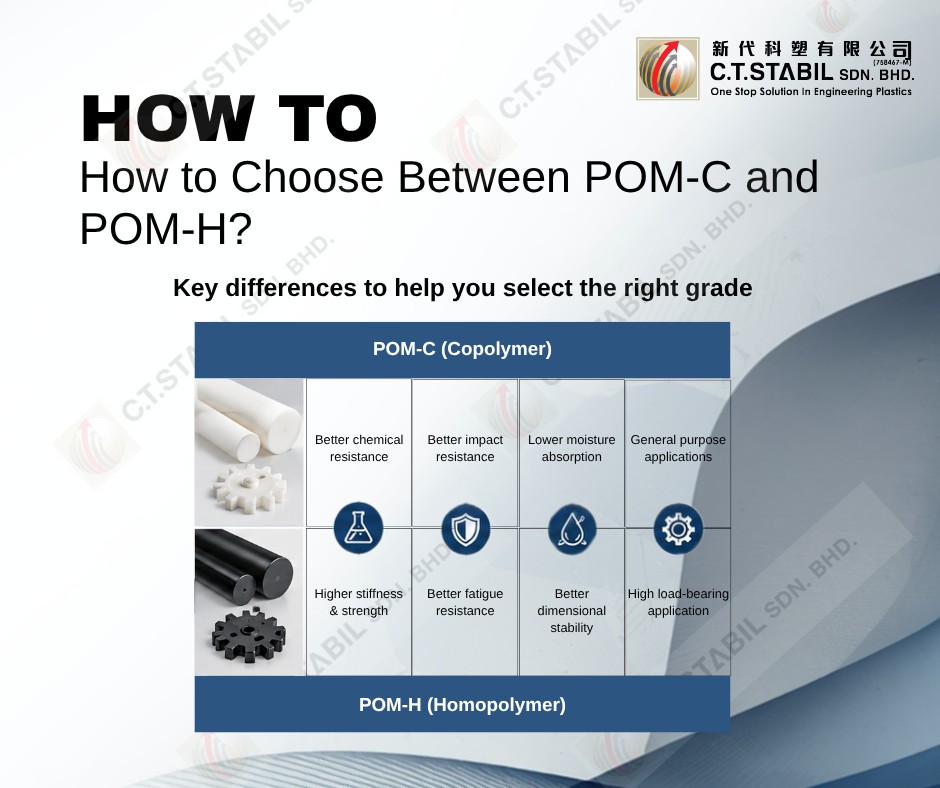
POM-C vs POM-H Comparison
| Property | POM-C | POM-H |
| Mechanical Strength | Excellent | Slightly higher |
| Stiffness | Excellent | Slightly higher |
| Wear Resistance | Excellent | Excellent |
| Dimensional Stability | Excellent | Very Good |
| Chemical Resistance | Better | Good |
| Moisture Absorption | Very Low | Very Low |
| Machinability | Excellent | Excellent |
| Centreline Porosity | Lower | Slightly higher in larger diameters |
| Typical Cost | Generally lower | Generally higher |
General comparison only. Performance may vary depending on manufacturer and material grade.
When Should You Choose POM-C?
POM-C is the most commonly used Acetal grade in general engineering applications.
It offers an excellent balance of mechanical performance, dimensional stability, and chemical resistance, making it suitable for a wide variety of precision-machined components.
POM-C is often recommended when:
- Components are exposed to moisture or cleaning chemicals.
- Better chemical resistance is required.
- Larger diameter rods are being machined.
- Lower centreline porosity is preferred.
- Cost efficiency is an important consideration.
Typical applications include:
- Conveyor components
- Bushings
- Rollers
- Wear pads
- Pump parts
- Valve components
- Food processing equipment
For many industrial applications, POM-C provides the best balance between performance and cost.
When Should You Choose POM-H?
POM-H offers slightly higher mechanical strength, stiffness, and hardness compared to POM-C.
These characteristics make it suitable for applications requiring higher rigidity or improved load-bearing capability.
Engineers may consider POM-H when:
- Maximum stiffness is required.
- Components experience higher mechanical loads.
- Increased hardness provides a design advantage.
- Slightly improved fatigue performance is desirable.
Typical applications include:
- Precision gears
- Structural mechanical components
- High-load bearings
- Mechanical drive systems
- Precision engineering parts
Although the performance differences are relatively small, they may become important in demanding engineering applications.
Is POM-H Always Better Than POM-C?
Not really.
One common misconception is that POM-H automatically outperforms POM-C because it offers slightly higher mechanical properties.
In reality, material selection depends on the operating environment.
For example, if a component is exposed to chemicals, moisture, or requires improved dimensional consistency in larger machined sections, POM-C may actually provide a better overall solution.
Similarly, if the application does not require the additional stiffness offered by POM-H, choosing POM-C may reduce material costs without sacrificing performance.
The best engineering solution is not always the material with the highest specification—it is the material that best matches the application’s requirements.
Factors to Consider Before Selecting POM
Before deciding between POM-C and POM-H, engineers should evaluate:
- Operating temperature
- Mechanical load
- Chemical exposure
- Moisture or humid environments
- Machining requirements
- Dimensional tolerances
- Component size
- Project budget
Considering these factors together helps ensure the selected material delivers reliable long-term performance.
Conclusion
Both POM-C and POM-H are outstanding engineering plastics that offer excellent wear resistance, dimensional stability, and machinability.
While POM-H provides slightly higher mechanical strength and stiffness, POM-C offers improved chemical resistance, lower centreline porosity, and excellent value for many industrial applications.
Rather than asking which material is “better,” engineers should focus on selecting the grade that best suits their operating conditions and design requirements.
At C.T. Stabil, we supply a wide range of engineering plastics and assist customers in selecting the most appropriate material based on application requirements, machining considerations, and long-term performance objectives.
Continue Learning
Expand your knowledge with these related articles: