


Why Is UHMW-PE So Wear Resistant?
5 – 6 minutes reading.
Ultra-High Molecular Weight Polyethylene, commonly known as UHMW-PE, is one of the most wear-resistant engineering plastics available today. It is widely used in industries such as mining, bulk material handling, food processing, packaging, and conveyor systems, where components are constantly exposed to friction, abrasion, and impact.
But what makes UHMW-PE so resistant to wear compared to many other engineering plastics?
The answer lies in its unique molecular structure, self-lubricating properties, and exceptional ability to absorb impact while resisting surface damage. Understanding these characteristics helps engineers select the right material for applications requiring long service life and reduced maintenance.
The Secret Lies in Its Molecular Structure
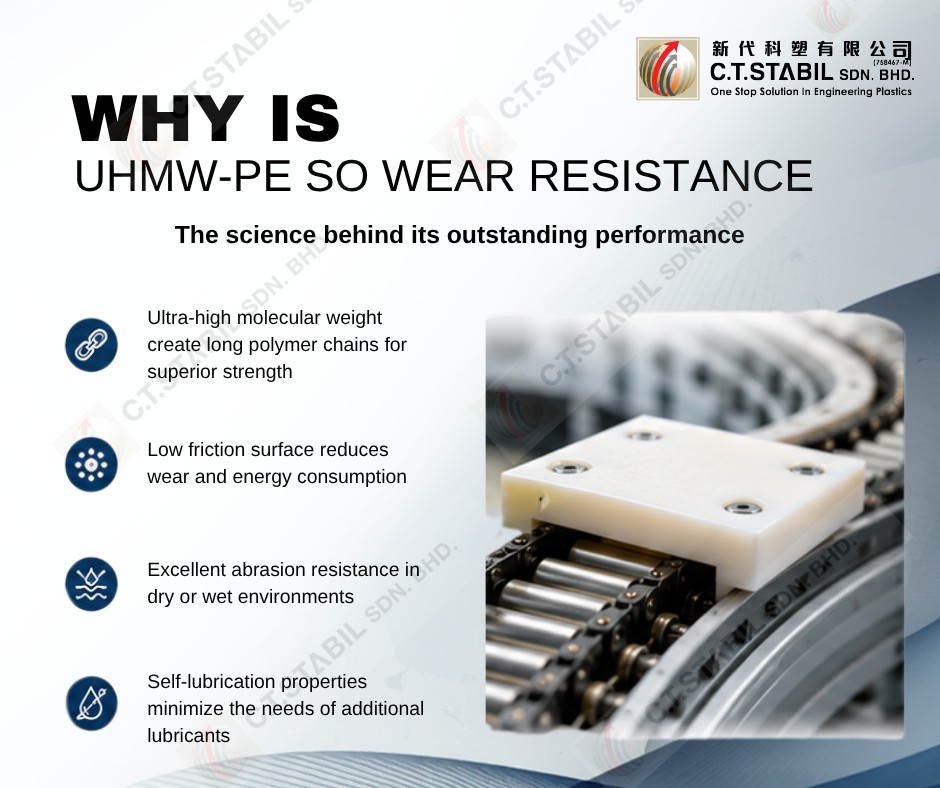
Unlike standard polyethylene, UHMW-PE has an extremely high molecular weight, typically ranging between 3 and 10 million g/mol.
This means its polymer chains are significantly longer than those found in conventional plastics.
Imagine a bowl of short strings compared to a bowl of long ropes. The long ropes become heavily intertwined, making them much more difficult to pull apart.
The same principle applies to UHMW-PE.
Its long molecular chains create a highly entangled internal structure that resists material removal when exposed to continuous sliding or abrasive contact. Instead of breaking away easily, the material distributes stresses throughout the polymer network, greatly reducing wear over time.
This unique structure forms the foundation of UHMW-PE’s outstanding wear performance.
Naturally Low Friction Reduces Wear
Wear is often caused by friction between two moving surfaces.
One reason UHMW-PE performs exceptionally well is its naturally low coefficient of friction, allowing surfaces to slide smoothly with minimal resistance.
Unlike many materials that require external lubrication, UHMW-PE exhibits self-lubricating characteristics. This reduces frictional heat, minimises surface damage, and helps extend the service life of both the UHMW-PE component and the mating surface.
These properties make UHMW-PE particularly suitable for applications involving continuous sliding or conveying operations.
Excellent Impact Resistance Prevents Surface Damage
Wear is not always caused by friction alone.
Many industrial components are also subjected to repeated impacts from moving products, bulk materials, or mechanical equipment.
UHMW-PE combines outstanding wear resistance with exceptional impact strength.
Rather than cracking or chipping under sudden loads, the material absorbs impact energy and distributes it throughout its molecular structure. This ability helps protect the surface from damage and contributes to a longer operating life, even in demanding industrial environments.
This is one reason why UHMW-PE is widely used in industries handling coal, aggregates, grains, minerals, and other abrasive bulk materials.
Outstanding Resistance to Abrasion
Abrasion occurs when rough particles repeatedly scrape against a material’s surface.
UHMW-PE performs exceptionally well in abrasive environments because its tough molecular structure resists surface erosion.
In applications such as conveyor liners, chute liners, hopper liners, and wear strips, abrasive materials slide across the surface continuously. Instead of rapidly wearing away, UHMW-PE maintains its integrity, reducing replacement frequency and maintenance costs.
For operations that run continuously, this durability can significantly improve equipment uptime.
Where Is UHMW-PE Commonly Used?
Because of its excellent wear resistance, UHMW-PE is widely used across many industries.
Typical applications include:
- Conveyor wear strips
- Chain guides
- Chute liners
- Hopper liners
- Star wheels
- Timing screws
- Guide rails
- Scraper blades
- Marine fender pads
- Food processing equipment
In many of these applications, UHMW-PE helps reduce friction, minimise noise, improve equipment efficiency, and extend component service life.
Does Wear Resistance Mean UHMW-PE Is Always the Best Choice?
Although UHMW-PE offers exceptional wear resistance, it is not the ideal material for every application.
Engineers should also consider operating temperature, mechanical load, dimensional stability, chemical exposure, and machining requirements before selecting a material.
For example:
- POM (Acetal) offers higher stiffness and better dimensional stability for precision-machined parts.
- PEEK provides significantly higher temperature resistance for demanding industrial environments.
- PTFE offers an even lower coefficient of friction for specialised low-friction applications.
Material selection should therefore balance wear resistance with the complete operating conditions of the application.
Conclusion
UHMW-PE’s exceptional wear resistance is not the result of a single property but rather a combination of its ultra-high molecular weight, long polymer chains, naturally low friction, excellent impact resistance, and outstanding abrasion resistance.
These characteristics make UHMW-PE one of the most trusted engineering plastics for components operating under continuous sliding, abrasive, and impact conditions.
However, every engineering application presents unique challenges. Selecting the most suitable engineering plastic requires evaluating operating conditions, mechanical requirements, and long-term performance rather than focusing on a single material property.
At C.T. Stabil, we help customers identify the most appropriate engineering plastic for their applications, ensuring the right balance between performance, durability, and cost.
Continue Learning
Interested in learning more about engineering plastics? Explore our related technical articles: