


Why Does PTFE Have Such a Low Coefficient of Friction?
5 – 6 minutes reading.
Polytetrafluoroethylene (PTFE) is widely recognised as one of the slipperiest engineering plastics available. Its exceptionally low coefficient of friction makes it an ideal material for applications where smooth movement, reduced wear, and minimal resistance are essential.
From bearings and seals to sliding components and non-stick industrial surfaces, PTFE has earned its reputation across industries including chemical processing, food manufacturing, pharmaceuticals, aerospace, and semiconductor production.
But what gives PTFE this remarkable low-friction characteristic?
The answer lies in its unique molecular structure, surface chemistry, and the way it interacts with other materials.
What Is the Coefficient of Friction?
The coefficient of friction (COF) is a measure of how much resistance occurs when two surfaces slide against each other.
A material with a high coefficient of friction requires more force to move, while a material with a low coefficient of friction slides more easily with less resistance.
For engineers, reducing friction can provide several advantages:
- Lower energy consumption
- Reduced component wear
- Less heat generation
- Smoother operation
- Longer equipment life
- Reduced maintenance
Among engineering plastics, PTFE is one of the lowest-friction materials available.
The Secret Lies in PTFE’s Molecular Structure
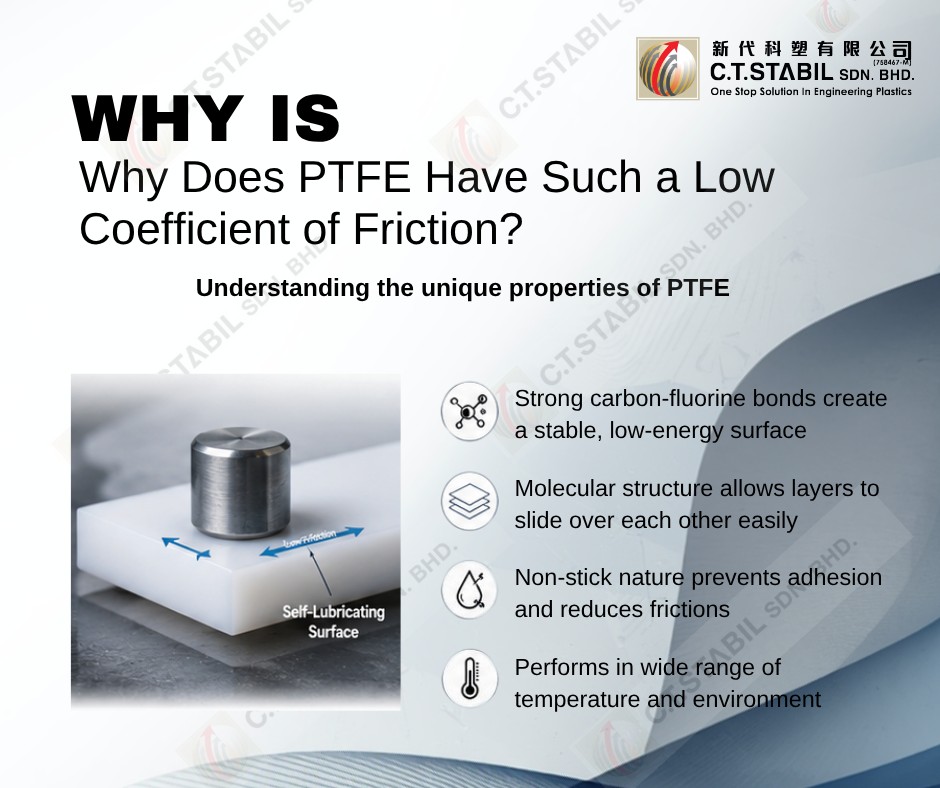
PTFE consists of long chains of carbon atoms completely surrounded by fluorine atoms.
These fluorine atoms form an extremely stable outer layer around the polymer chain.
This protective layer creates a smooth, chemically inert surface that resists interaction with other materials.
Imagine trying to grip an object coated with ice.
Because there is very little interaction between the surfaces, they slide easily past one another.
PTFE behaves in a similar way at the molecular level.
Its surface is so chemically stable that other materials find it difficult to adhere to or grip it, resulting in exceptionally low friction.
This unique molecular arrangement is the primary reason PTFE performs so well in sliding applications.
PTFE Is Naturally Self-Lubricating
Unlike many engineering materials, PTFE does not require external lubrication to achieve smooth movement.
Its surface naturally provides low friction, allowing components to operate efficiently even where oils or greases are undesirable.
This characteristic makes PTFE particularly valuable in industries where contamination from lubricants must be avoided, such as:
- Food processing
- Pharmaceutical manufacturing
- Medical equipment
- Semiconductor production
In many applications, PTFE helps simplify maintenance while improving equipment reliability.
Low Friction Also Reduces Wear
Although friction and wear are different phenomena, they are closely related.
Lower friction generally means less surface contact and reduced heat generation, which helps minimise wear on both the PTFE component and its mating surface.
This is one reason PTFE is frequently used in:
- Bearings
- Bushings
- Slide plates
- Wear pads
- Guide rails
- Valve seats
- Sealing components
In dynamic applications, reduced friction often translates into longer service life and improved operating efficiency.
Common Applications of PTFE
PTFE’s combination of low friction, excellent chemical resistance, and wide operating temperature range makes it suitable for numerous industrial applications.
Typical examples include:
- Chemical seals
- Valve seats
- Pump components
- Bearings
- Bushings
- Conveyor guide components
- Electrical insulation
- Non-stick processing surfaces
- Gaskets
- Laboratory equipment
In chemically aggressive environments, PTFE is often selected because it combines excellent corrosion resistance with outstanding sliding performance.
Is PTFE Always the Best Choice for Low-Friction Applications?
Not really.
Although PTFE offers one of the lowest coefficients of friction among engineering plastics, other material properties should also be considered during material selection.
For example:
- UHMW-PE offers excellent wear resistance and impact strength for conveyor and material handling applications.
- POM (Acetal) provides greater stiffness and dimensional stability for precision-machined components.
- PEEK combines low friction with significantly higher mechanical strength and high-temperature performance.
Selecting the right engineering plastic requires balancing friction, mechanical loading, wear resistance, operating temperature, chemical exposure, and overall cost.
Conclusion
PTFE’s exceptionally low coefficient of friction is the result of its unique molecular structure and highly stable fluorine-rich surface, which allows materials to slide easily with minimal resistance.
Combined with excellent chemical resistance, wide operating temperature capability, and natural self-lubricating properties, PTFE has become one of the most versatile engineering plastics for demanding industrial applications.
However, the best engineering solution is not always the material with the lowest friction. Successful material selection considers the complete operating environment, ensuring the chosen material delivers the right balance of performance, durability, and cost.
At C.T. Stabil, we help customers evaluate these requirements to recommend the most suitable engineering plastic for every application.
Continue Learning
Interested in learning more about engineering plastics? Explore our related technical articles: