


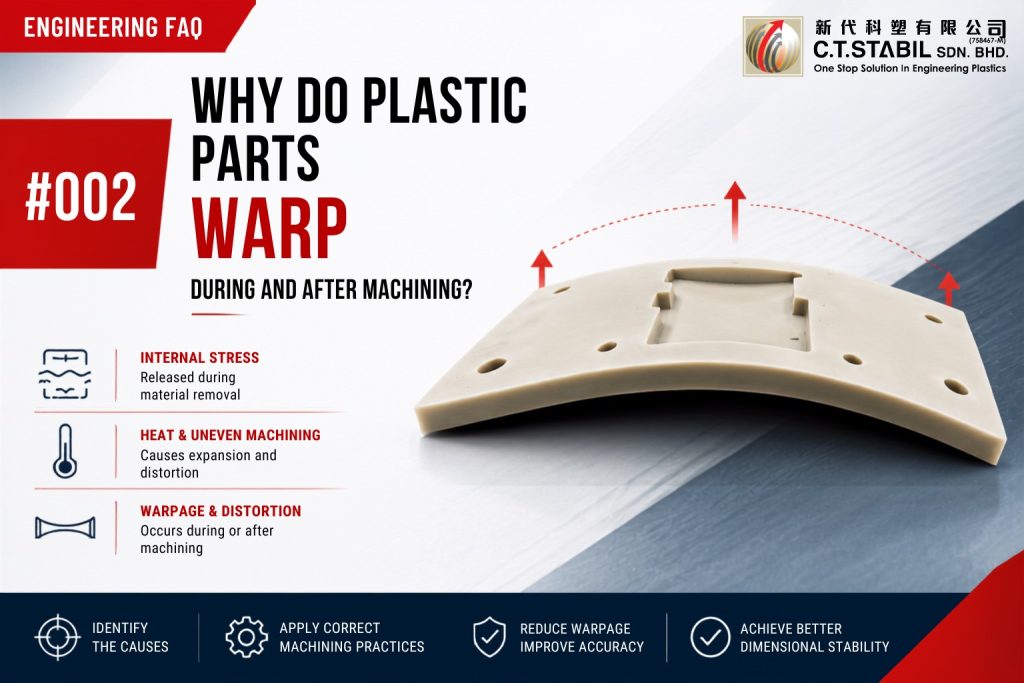
Engineering FAQ #002 – Why Do Plastic Parts Warp During and After Machining?
4 minutes reading
⭐ Quick Answer
Plastic parts may warp during or after machining because internal stresses are released as material is removed. Uneven machining, excessive heat, poor workholding, moisture absorption, and part geometry can all contribute to dimensional movement.
In most cases, the material itself is not defective. Warpage is usually the result of how the material is machined, supported, or designed. By understanding these factors, engineers and machinists can significantly improve dimensional accuracy and reduce costly rework.
Introduction
Few machining issues are more frustrating than producing a perfectly flat plastic component, only to find that it has distorted several hours later or after being removed from the machine.
Unlike metals, engineering plastics respond differently to machining because they have lower stiffness, higher thermal expansion, and may contain residual stresses from the manufacturing process. As material is removed, these stresses can be released, causing the part to bend, twist, or lose dimensional accuracy.
Understanding why warpage occurs is the first step towards preventing it.
What Causes Plastic Parts to Warp?
1. Residual Internal Stress
Many engineering plastics contain internal stresses introduced during extrusion or casting. When machining removes material from one side of the workpiece, these stresses become unbalanced and the part may distort.
This is one of the most common causes of warpage in machined plastic components.
2. Uneven Material Removal
Removing a large amount of material from only one side of a plate changes the internal stress distribution.
For example, machining a deep pocket on one face while leaving the opposite face untouched often causes the component to bend after it is unclamped.
Whenever possible, remove material progressively and maintain a balanced machining strategy.
3. Heat Generated During Machining
Engineering plastics do not dissipate heat as efficiently as metals.
Dull cutting tools, excessive spindle speeds, or aggressive cutting parameters can generate localised heat, causing temporary expansion and increasing internal stress. Once the part cools, dimensional movement may occur.
Using sharp tools and appropriate machining parameters helps minimise heat build-up.
4. Incorrect Workholding
Excessive clamping force can temporarily deform a plastic workpiece during machining.
Once the clamps are released, the material relaxes and may no longer retain its machined dimensions.
The workpiece should be held securely, but without introducing unnecessary mechanical stress.
5. Material Characteristics
Different engineering plastics respond differently to machining.
For example, materials such as Nylon may experience additional dimensional changes because of moisture absorption, while other plastics may exhibit different levels of residual stress depending on their manufacturing process.
Selecting the appropriate material for the application’s dimensional requirements is therefore an important part of the engineering decision.
How to Reduce Warpage
Most machining-related warpage can be minimised by following good machining practices:
- Machine both sides of the component progressively whenever practical.
- Leave sufficient material for a final finishing pass.
- Use sharp cutting tools designed for plastics.
- Optimise cutting speeds and feed rates to reduce heat generation.
- Avoid excessive clamping pressure.
- Consider stress-relieving procedures for critical components where appropriate.
- Allow components to stabilise before performing final precision machining if high accuracy is required.
💡 Workshop Tip
A common workshop practice is to rough-machine the component first, allow it to rest, then perform the final finishing operation.
This short stabilisation period allows internal stresses to relax before the final dimensions are machined, helping to improve flatness and dimensional accuracy—especially for larger plates and precision components.
Conclusion
Warpage after machining is usually not caused by defective material but by the interaction between residual stress, machining methods, heat, workholding, and component design.
By understanding how engineering plastics behave during machining and applying appropriate machining practices, manufacturers can significantly reduce distortion, improve dimensional accuracy, and minimise costly rework.