


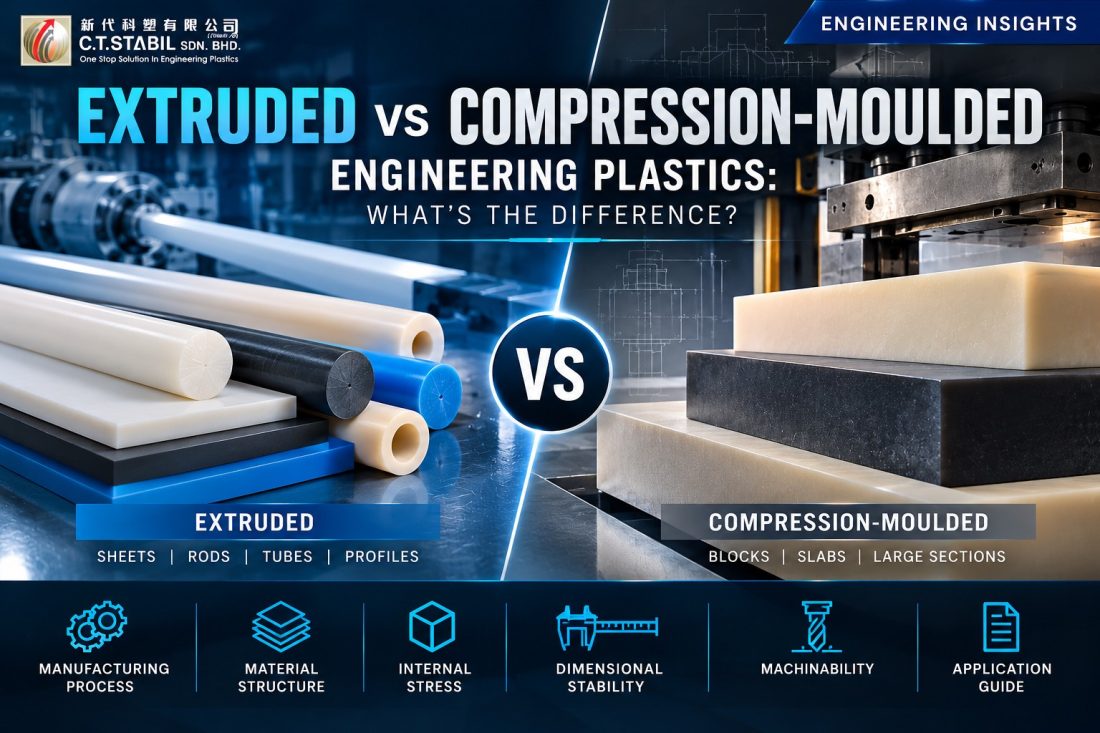
Extruded vs Compression-Moulded Engineering Plastics: What’s the Difference?
Knowledge Center | Engineering Insights
10 to 12 minutes reading
Introduction: Does the Manufacturing Process Matter?
When selecting engineering plastics for machining, engineers often focus on material properties such as strength, wear resistance, operating temperature and chemical resistance.
However, there is another important consideration: how the raw material was manufactured.
Extrusion and compression moulding are two common methods used to produce engineering plastic stock for further processing. Both can produce high-quality materials, but they differ in how the polymer is formed, how material properties may develop and how the stock behaves during machining.
These differences can influence dimensional stability, residual stress, directional properties, material availability and overall production cost.
For example, two stock pieces made from the same polymer family may behave differently during machining because of their dimensions, processing history, cooling conditions and manufacturing quality.
Understanding the differences between extruded and compression-moulded engineering plastics helps engineers and machinists make better-informed decisions before purchasing raw material or starting production.
1. What Are Extruded Engineering Plastics?
Extrusion is a continuous manufacturing process in which polymer material is heated until it can flow, then pushed through a shaped die to produce stock with a consistent cross-section.
Depending on the material and production equipment, extruded engineering plastics are available in forms such as sheets, rods, tubes and profiles.
How the extrusion process works
- Polymer feedstock is supplied to the extrusion system.
- Heat and mechanical action soften or melt the polymer.
- The material is pushed through a die to create the required cross-sectional shape.
- The extruded material is cooled and calibrated to achieve the required dimensions.
- The finished stock is cut to length or supplied in standard sizes.
The precise process varies by polymer and manufacturer. Temperature control, extrusion speed, cooling rate and calibration can all affect the final material.
Advantages of extrusion
Continuous production: Extrusion is well suited to producing long lengths of stock and repeatable cross-sectional shapes.
Standard-size availability: Many commonly used engineering plastics are available as extruded sheets, rods and tubes.
Production efficiency: Continuous manufacturing can be economical for standard sizes and larger production volumes.
Broad application range: Extruded stock is commonly used for machined bushings, rollers, gears, guide components, wear strips and general-purpose engineering parts.
Considerations when selecting extruded stock
Extrusion can create directional differences in polymer structure and properties because material flows through a die during production. The extent of these differences depends on the polymer, processing conditions and stock geometry.
Cooling and processing history can also influence residual stress. If the material is machined asymmetrically or a large amount of material is removed, stress redistribution may contribute to dimensional changes.
These effects are not inevitable in every extruded product. Manufacturing quality, grade selection and the supplier’s process controls remain important.
2. What Are Compression-Moulded Engineering Plastics?
Compression moulding forms polymer material inside a mould by applying heat and pressure. Depending on the polymer, the feed material may be a solid preform, granules, powder or another suitable form.
The material is heated and consolidated within the mould, then cooled or otherwise processed according to the manufacturer’s requirements.
Compression moulding is used for selected engineering plastics and can be particularly useful for producing thick sections, large blocks and stock shapes that are difficult or uneconomical to manufacture through other routes.
How the compression-moulding process works
- A measured quantity of polymer feed material is placed in a mould.
- Heat softens or consolidates the material, depending on the polymer and process.
- Pressure helps the material fill the mould and consolidate.
- The material is cooled or processed according to the required production cycle.
- The finished block, slab or other stock shape is removed and prepared for inspection or further machining.
Not every polymer is suitable for every compression-moulding process. The method must be compatible with the material’s processing characteristics and the manufacturer’s equipment.
Advantages of compression-moulded stock
Thick sections and large blocks: Compression moulding can be suitable for producing substantial stock dimensions for large machined components.
Different production options: Depending on the polymer and supplier, moulding can provide stock dimensions and shapes that may not be readily available through extrusion.
Potentially favourable stress distribution: A well-controlled moulding process can produce stock with suitable stress characteristics for particular machining applications. However, this is not guaranteed by the process name alone.
Application flexibility: Large blocks can be machined into housings, plates, fixtures, structural components and other parts where substantial material removal is required.
Considerations when selecting compression-moulded stock
Heating, consolidation and cooling can create temperature gradients and residual stresses. The magnitude and distribution of these stresses depend on the material, block dimensions, mould design and process controls.
Large or thick stock may require particular attention to cooling, conditioning and machining strategy.
Compression-moulded material should therefore not automatically be assumed to have lower internal stress, better flatness or superior dimensional stability than extruded stock. These characteristics must be assessed for the specific grade and product.
3. Extruded vs Compression-Moulded Engineering Plastics: Key Differences
Although both methods produce stock for machining, their typical production characteristics differ.
| Comparison | Extruded stock | Compression-moulded stock |
|---|---|---|
| Manufacturing method | Continuous forming through a die | Heat and pressure applied in a mould |
| Common stock forms | Sheets, rods, tubes and profiles | Blocks, slabs and selected moulded stock forms |
| Production approach | Well suited to continuous production | Batch or cycle-based moulding |
| Directional properties | Flow during extrusion may create directional differences | Properties depend on material flow, consolidation and moulding conditions |
| Residual stress | Can arise from flow, cooling and calibration | Can arise from temperature gradients, consolidation and cooling |
| Thick-section availability | Depends on material, equipment and supplier capabilities | Can be suitable for substantial sections, depending on the polymer and process |
| Machining behaviour | Depends on grade, stock dimensions, stress distribution and machining method | Depends on grade, block dimensions, stress distribution and machining method |
| Cost considerations | Can be economical for standard sizes and continuous production | Economics depend on moulding cycle, stock size, material and production volume |
This table describes general process tendencies, not universal performance rankings. Actual stock quality and machining behaviour should be confirmed using the supplier’s technical information and, where necessary, application testing.
4. How Does Manufacturing Method Affect Internal Stress?
Internal stress is an important consideration when machining engineering plastics.
Residual stress refers to stress that remains in a material even when no external load is being applied. It may develop during processing because different regions of the polymer experience different flow, cooling, shrinkage or structural changes.
Both extrusion and compression moulding can produce residual stress.
Internal stress in extruded plastics
During extrusion, polymer flow and subsequent cooling can create differences across the stock section. The resulting stress distribution depends on the material, extrusion conditions, cooling process and geometry.
When machining removes material from one side or from the interior of a component, the original stress balance can change. This may lead to bowing, twisting or dimensional movement.
Internal stress in compression-moulded plastics
During compression moulding, the material may experience temperature and pressure differences across the moulded section. Uneven cooling or shrinkage can contribute to residual stress.
Thick blocks deserve particular attention because their interior and exterior may cool at different rates. However, the actual stress profile varies by material and manufacturing process.
Why does this matter during machining?
Consider a thick engineering plastic block used to manufacture a precision fixture. If a large amount of material is removed from one side, the stress balance may change and the component may distort.
This is why manufacturing method alone is not enough to predict machining performance. Stock dimensions, material grade, supplier process controls, component geometry and the machining sequence must all be considered.
5. Which Process Provides Better Dimensional Stability?
There is no universal answer.
Dimensional stability depends on the polymer’s properties, stock geometry, processing history, environmental conditions and machining requirements.
A carefully manufactured extruded sheet may provide excellent dimensional stability for its intended application. A properly produced compression-moulded block may also perform well, including in applications involving substantial machining.
Likewise, either type of stock can distort if it contains significant residual stress or is machined under unsuitable conditions.
When dimensional accuracy is critical, consider the following factors:
- Material grade: Different grades of the same polymer may have different processing characteristics and dimensional behaviour.
- Stock thickness and size: Larger sections may have different cooling and stress profiles.
- Machining allowance: The amount and distribution of material removed can affect stress redistribution.
- Component geometry: Thin walls, asymmetric shapes and deep pockets can increase the risk of distortion.
- Operating environment: Temperature changes and moisture absorption can affect dimensions after machining.
- Supplier quality: Manufacturing consistency, inspection practices and documented technical data are important.
For high-precision components, request information on the specific stock grade and manufacturing route rather than selecting a material solely because it is described as extruded or compression-moulded.
6. How Should You Choose the Right Stock for Machining?
The best choice starts with the finished component’s requirements.
Choose extruded stock when it suits the required shape and application
Extruded sheets, rods and tubes can be suitable for:
- Standard-size components and repeat production.
- Bushings, rollers, guide rails and wear strips.
- Components made from stock that is readily available in the required dimensions.
- Applications where the material’s documented properties and machining behaviour meet the design requirements.
Before machining critical parts, consider the stock dimensions, expected material removal and the supplier’s recommendations.
Consider compression-moulded stock when its dimensions or characteristics suit the job
Compression-moulded blocks or slabs may be worth considering for:
- Large machined components.
- Thick sections that are not readily available in the required form through extrusion.
- Components requiring substantial material removal.
- Applications where the supplier can demonstrate that the specific stock is suitable for the required dimensional and mechanical performance.
The decision should still be based on the actual material grade, stock quality, size availability, cost and machining requirements.
A practical selection checklist
Before ordering engineering plastic stock, ask:
- Is the required sheet, rod, tube or block size available?
- What manufacturing process was used for this specific product?
- Are there documented dimensional tolerances and material specifications?
- Is residual stress or stress-relief information available where relevant?
- How much material will be removed during machining?
- Are the finished component’s flatness and dimensional tolerances achievable?
- Will temperature, humidity, chemical exposure or mechanical loads affect the part in service?
- Is the material available consistently at a commercially reasonable cost?
For critical applications, trial machining and dimensional inspection can provide more useful evidence than assuming one process is always better.
7. Machining Tips for Better Dimensional Accuracy
Regardless of whether stock is extruded or compression-moulded, good machining practice can help reduce dimensional problems.
Inspect incoming stock. Check dimensions, flatness and visible defects before machining. Record any significant deviations.
Allow temperature stabilisation. Where the material has experienced substantial temperature changes, allow it to reach a suitable, stable working temperature before precision measurement or machining.
Use staged material removal where appropriate. Rough machining followed by a stabilisation period and finish machining may help manage distortion in stress-sensitive components. The procedure should be suitable for the material and geometry.
Avoid unnecessary asymmetric removal. Where the design allows, balanced material removal may reduce the risk of distortion caused by changes in the stress distribution.
Follow supplier recommendations. Stress-relief treatments and machining parameters differ between polymers. Do not apply a generic heating cycle to an engineering plastic without confirming that it is suitable for the specific grade.
Inspect after machining. Measure the finished component under consistent conditions and, where appropriate, recheck critical dimensions after stabilisation.
These practices cannot eliminate every source of distortion, but they help establish a more controlled manufacturing process.
Conclusion: Choose Based on the Application, Not the Process Name
Extrusion and compression moulding are both valuable manufacturing methods for engineering plastic stock. Extrusion supports continuous production of sheets, rods, tubes and profiles, while compression moulding can be useful for producing selected blocks, slabs and substantial stock sections.
Both processes can influence material structure, residual stress and machining behaviour. Neither method automatically guarantees superior dimensional stability, lower internal stress or better machinability.
For engineers and machinists, the most reliable approach is to evaluate the specific polymer grade, stock dimensions, manufacturing quality, machining allowance and operating environment.
At C.T. Stabil, understanding both material properties and manufacturing methods helps customers select engineering plastics that meet their component requirements more effectively.
Need help selecting the right engineering plastic stock? Contact C.T. Stabil to discuss your material, stock dimensions, machining requirements and application.
Frequently Asked Questions
Is compression-moulded plastic always better for precision machining?
No. Precision machining performance depends on the material grade, stock quality, stress distribution, component geometry and machining method. Some extruded products perform very well in precision applications.
Does extruded engineering plastic always contain more internal stress?
No. Extrusion can produce directional properties and residual stress, but the amount depends on the polymer and processing conditions. Compression-moulded stock can also contain residual stress from consolidation and cooling.
Which process is better for thick engineering plastic blocks?
Compression moulding may be suitable for some thick or large stock sections, depending on the polymer and supplier’s capabilities. Availability, cost, stress characteristics and machining requirements should be evaluated for the specific product.
Can manufacturing method affect warping after machining?
Yes. Manufacturing history can influence residual stress, which may redistribute as material is removed. However, warping can also result from machining conditions, temperature changes, material properties and component geometry.
Should I choose extrusion or compression moulding based on price alone?
No. Consider the total cost, including raw material, availability, machining time, scrap risk, dimensional requirements and production volume. A lower purchase price may not provide the lowest overall manufacturing cost.
Suggested Internal Links
Add contextual links to these existing CTS Stabil Knowledge Center articles:
- How to Choose Between POM-C and POM-H?
- What Is PEEK? Properties, Applications and Benefits
- What Is Ertalyte™ PET-P – How Is It Different From Other PET Brands?
- Why Does Moisture Absorption Affect Plastic Dimensions?
- Which Engineering Plastic Has the Highest Operating Temperature?
About CT Stabil Technical Publications
C.T. Stabil Technical Publications is a knowledge series created to help engineers, designers, purchasers, and manufacturers better understand engineering plastics and make informed material selection decisions.
Our publications combine engineering principles, recognised industry practices, manufacturer technical information, and practical application experience to deliver objective, educational, and application-focused content.
Our mission is to simplify complex material selection decisions while promoting sound engineering practices across a wide range of industrial applications.
Article Information
| Information | Details |
| Series | Engineering Insight |
| Publication No. | CTS-EI-003 |
| Article Title | Extruded vs Compression-Moulded Engineering Plastics: What’s the Difference? |
| Technical Level | Advanced |
| Estimated Reading Time | 10 -12 min read |
| Published | October 2026 |
| Last Reviewed | October 2026 |
| Prepared by | C.T. Stabil Technical Publications |
| Technical Review | C.T. Stabil Engineering Team |
Technical Disclaimer
This publication is intended for educational and general engineering reference purposes only.
The information presented reflects commonly accepted engineering principles together with industry references available at the time of publication. Material properties, performance characteristics, and application suitability may vary depending on the manufacturer, material grade, processing methods, operating conditions, component design, and service environment.
Readers should verify all technical information and consult the relevant manufacturer’s technical documentation before making engineering, design, or purchasing decisions.
Nothing contained in this publication should be interpreted as a substitute for professional engineering judgement or application-specific testing.
Copyright Notice
© 2026 CT Stabil Sdn. Bhd. All rights reserved.
This publication forms part of the C.T. Stabil Technical Publications series.
You may quote brief excerpts from this publication for educational or editorial purposes provided appropriate attribution is given to CT Stabil Sdn. Bhd.
Reproduction, republication, or redistribution of this publication in whole or in substantial part without prior written permission is prohibited.
References & Further Reading
The information presented in this publication has been prepared with reference to recognised engineering resources, including:
- Manufacturer technical data for commercially available PPS materials
- Material property information published by leading engineering plastics manufacturers
- ASTM International standards relating to plastics testing and material characterisation
- ISO standards relevant to engineering plastics
- Engineering plastics reference handbooks
- Practical engineering knowledge and application experience from the C.T. Stabil Engineering Team