


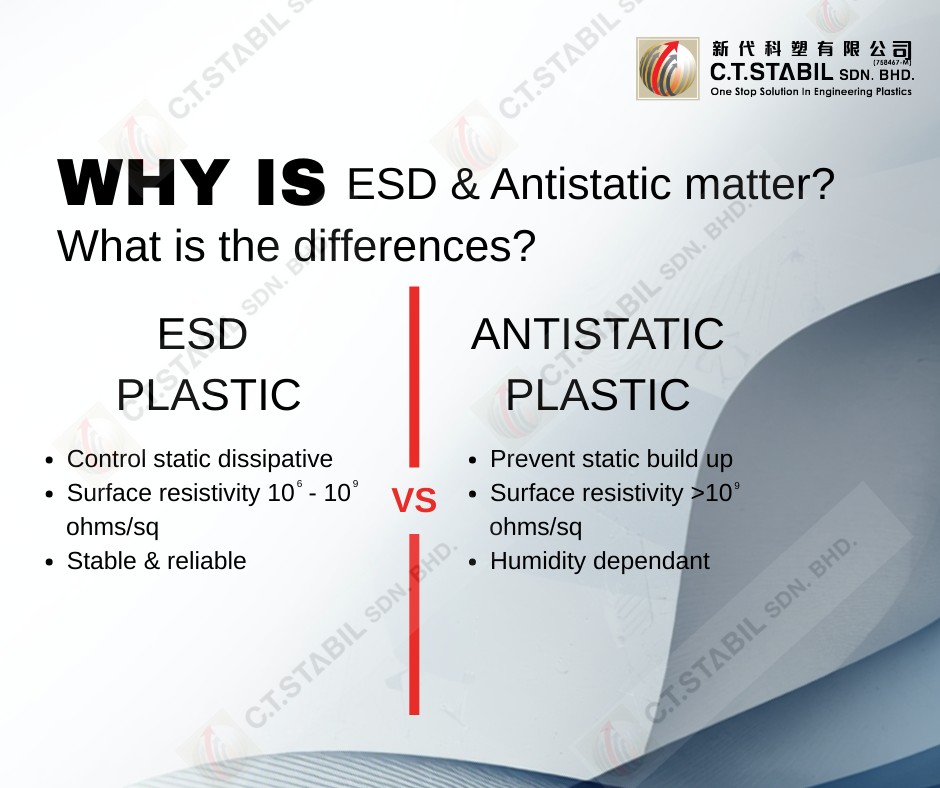
Why is ESD & Antistatic matter? What is the differences?
Electrostatic Dissipative (ESD) vs Antistatic Plastics: What’s the Difference and Why It Matters
Static electricity is an invisible but very real challenge in many industrial environments. From electronics manufacturing to cleanrooms and chemical processing, uncontrolled static can damage sensitive components, attract dust, or even trigger sparks. This is where antistatic and electrostatic dissipative (ESD) plastics come into play. Although these terms are often used interchangeably, they serve different purposes and performance levels.
What Is Antistatic?
Antistatic materials are designed to reduce the build-up of static electricity. They work by limiting the initial generation of static charges, usually through additives that attract moisture from the air or slightly increase surface conductivity.
In plastics, antistatic performance is typically achieved by adding antistatic agents into materials such as polypropylene (PP), polyethylene (PE), acetal (POM), PVC etc. These agents allow charges to bleed off slowly into the surrounding air, preventing sudden static accumulation.
Key characteristics of antistatic plastics:
- Surface resistivity usually above 10¹⁰ ohms/sq
- Prevents static build-up, but does not actively control discharge
- Performance may depend on humidity and can diminish over time
- Suitable for packaging, storage bins, trays, and consumer products
Antistatic plastics are ideal where static is a nuisance but not a critical risk.
What Is Electrostatic Dissipative (ESD)?
Electrostatic dissipative (ESD) materials go a step further. They are engineered to safely and predictably dissipate static charges to ground at a controlled rate. This prevents sudden electrostatic discharge that could damage sensitive electronics or ignite flammable environments.
ESD plastics often use conductive fillers such as carbon, specialized polymers, or engineered coatings to achieve stable electrical properties throughout the material.
Key characteristics of ESD plastics:
- Surface resistivity typically between 10⁶ and 10⁹ ohms/sq
- Provides controlled dissipation of static electricity
- Stable, long-term performance independent of humidity
- Commonly used in electronics, semiconductor, and cleanroom industries
Antistatic vs ESD: The Key Difference
The main difference lies in control and reliability. Antistatic plastics reduce static generation, while ESD plastics actively manage and dissipate static charges in a controlled manner. In environments with sensitive electronic components, antistatic materials may not be sufficient—ESD-safe materials are required.
Applications in Plastics
For example, antistatic plastic sheets may be used for protective covers, general packaging, or material handling trays. ESD plastic sheets and rods, on the other hand, are widely used for electronic workbenches, machine parts, jigs, fixtures, and component carriers where static damage must be avoided.
Conclusion
Choosing between antistatic and ESD plastics depends on your application’s risk level. If static is merely inconvenient, antistatic materials may suffice. But when product safety, precision, and reliability matter, ESD plastics are the safer and more professional solution.